Sunday, 16 June 2019

Shang Da Ren cards 2 - Hubei

"Shashi Excellent Shang Da Ren cards" , Shashi, 96c.
《沙石精品上大人》,沙石, 96 副

These cards are popularly used in Wuhan, a place in Hubei. Unlike the cards featured previously These cards have a variant form of the text. The text is identical to the standard version, except the last line/ This reads Fu Lu Shou 福祿壽 "Fortune, Rank and Longevity" instead of the usual Ke Zhi Li 可知禮 "And hence understand courtesy and manners" . Decks that possess such an alteration are called 'Fu Lu Shou cards"; indeed, a game bears this name

The altered text thus reads as follows:

Ch
Pinyin
Translation, after Hans Steinmüller
上大人
Shang da ren
His greatness,
孔乙己
Kong Yi Ji
Confucius,
化三千
Hua San Qian
has taught three thousand children,
七十士
Qi Shi Shi
of which Seventy became virtuous scholars.
爾小生
Er Xiao Shen
A young scholar like you,
八九子
Ba Jiu Zi
should study from eight or Nine sages,
往作仁
Wang zuo ren
should learn to be benevolent,
福祿壽
Ful Lu Shou
Fortune, Rank, Longevity"
N.B. The author has altered The last line of Hans Steinmüller's translation to reflect the Deck's composition. 

It is tempting to read the altered last line, as describing the benefits of being benevolent. Or it could be an attempt to inject an added layer of auspiciousness to the cards.

N.B. The numbers are ordered from Right to Left 
1:上   2:大   3:人   4:孔  5:乙   6:己
The First Six cards. The most notable feature of the cards, is they are coloured. The colours follow a consistent pattern-- Red for the first character of each line, Green for the second, and black for the third. 
The other notable feature of this deck in particular are the 'indices' In the top left-hand corner, rendering the cards in a more legible font. This is rather helpful. Note the great variance on the way the character on card 4 ("Confucius")  is written, and its standard form 孔. 

 7:化   8:三   9:千 10:七   11:十   12 :士   
The next six cards. Note card 8 ("Three"), written in a manner that suggests brushstrokes. 

13:尔(=爾) 14:小 15:生   16: 八   17 :九  18 :子
Card No. 13 ('You') is written using the cursive form of the character 爾. 

19: 佳 20: 作 21:仁 22:福 23:祿  24:壽
The last two lines. Cards 22-23 are particularly stylized. 
As mentioned above, the last three characters read "Fortune, Rank and Longevity" instead of the usual "And hence understand courtesy and manners“。 

The box contains the delightful inscription

严禁賭博
仅供娛乐
Yan Jin Dubo
Jin Gong Yu Le
Gambling strictly prohibited;
For leisure only


Wednesday, 22 May 2019

Four colour cards [3] Guangshui Cards

[four colour cards] Anon, 112c, China
《四色牌》112副
This deck comes from Guangshui, 廣水 a city in Hubei 湖北,

The red and white suits. The first thing to note is the form the characters take. They have become extremely stylized. My transcriptions into standard font are seen below, as well as their English equivalents. As for the Valet and Soldier, I am not certain about their identification, and they may have been transposed. 
The backs of the cards (A) are plain, grey cardboard. Note, that in the white suit the cards have a small tinge of red on their narrow edge. 

The green and Yellow suit. For a comparison, see here,"Hokkien"  "Double Phoenix" and  Singaporean  Cards. 
Note that all the characters in the four suits are identical in this deck. 

The Chinese Wikipedia has an Article about the cards, and the game played with them. 

Tuesday, 16 April 2019

[Money suited cards], "Everybody prosper"

[Money suited cards],  "Everybody prosper-- 120c. 
大家發, 120c. 

These cards are money-suited cards. They are relatively smaller than other examples of the genre (9x2.5cm).  They are used in Jining (濟寧/济宁) in Shandong (Shantung), China. These cards bear a similarity to the Ceki cards of Southeast Asia. 


The Suit of Coins. From Right to left, are the Ace, to Nine. 
The suit of coins is especially similar to the Ceki deck-- Note the leaf on the 7 of coins, and 
There is one extra card. (A). I do not know what the Chinese call it. It is superficially similar to the ace of coins. 

The Suit of Strings. The strings are bulbous in form.
Like decks previously featured here [ vide "Chik Kee Cards" , Nantong pattern ], the various ranks possess a form of index system, in the form of shapes cut into the card's black borders. 


The Suit of myriads, The characters are less abstract than the cards in the ceki deck, but still fairly stylized, somewhat resembling masks.  Unlike other cards of this genre, the personages are named. They are characters from the Water Margin. The characters are: 

9 -- Song Jiang, leader of the 108 outlaws
8-- Zhu Tong.
7-- Tai Ming
6-- Li Hou
5-- Li Kuei
4-- Zi jin
3--  Da Dao
2-- Hua Rong
1-- Yan Qing

The card marked C is the 老千Lao Qian-- Old Thousand. The character depicted is Shui Qing 水青


Tuesday, 5 March 2019

Transparent playing cards (2)

Transparent Playing cards, Anon, 52+2c. 

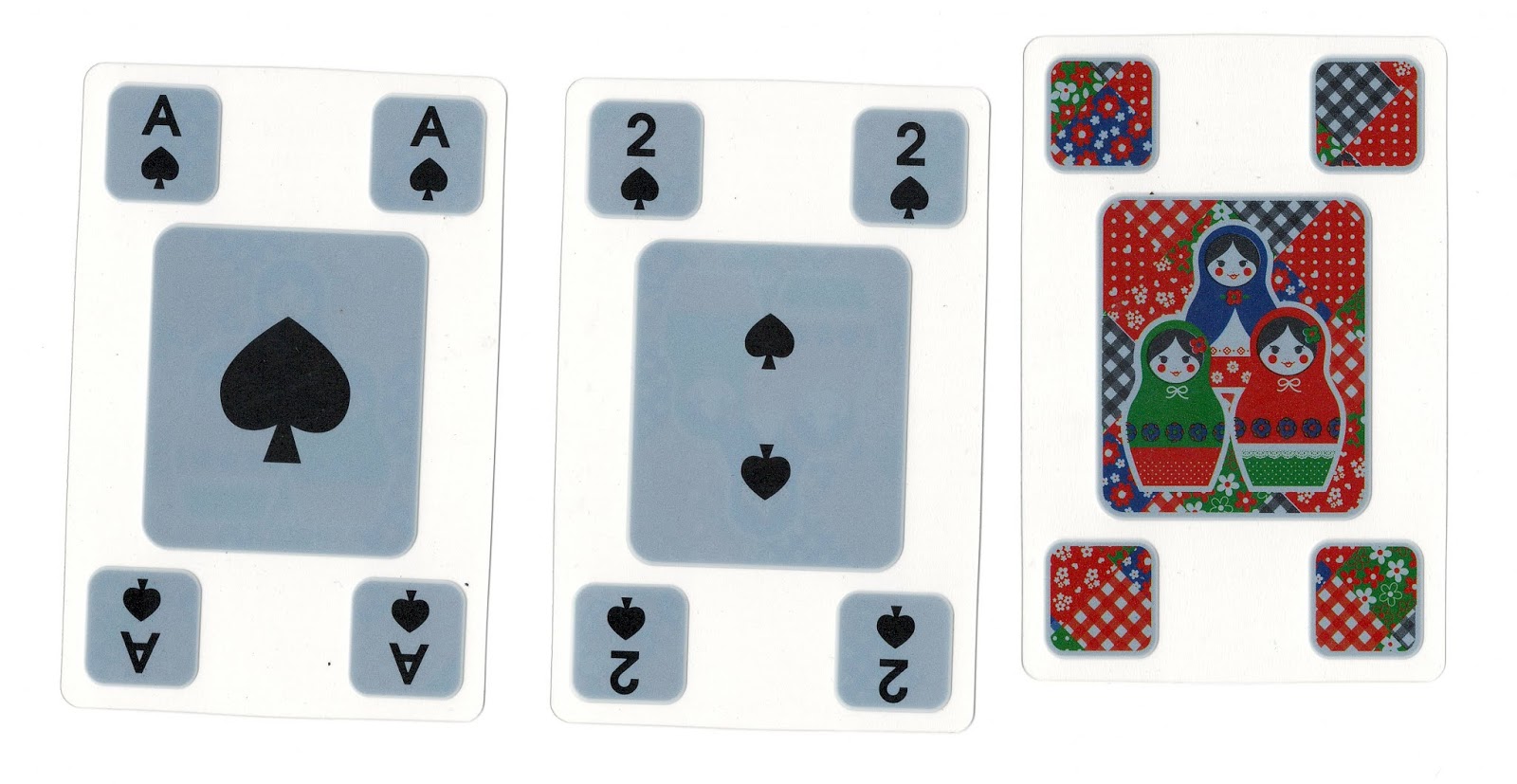
Here is another example of Transparent playing cards.  See here for one previously featured, and for a fuller explanation of the cards. The author recalls that this deck ( as well as the previous one) was purchased in the Japanese discount store Daiso. 

 The cards in this deck are slightly more complex than the one previously featured, Instead of simple indices, the pips are actually depicted on the cards. In turn there are also four indices to each card, instead of two. The back displays a charming design of Matryoshka
More cards are here depicted. they are overlaid with text, to show their transparency. Like the previous deck, the manufacturer has printed patches of opaque ink on the otherwise transparent cards. On these patches are printed the pips. 
Note the unusual arrangement of the pips, as well as the non-figurative court-cards. The Joker, meanwhile retains a human appearance 

Unfortunately, the opaque parts of the cards are not so opaque when strong light is shone against them. 

Tuesday, 5 February 2019

Chinese domino cards

[Chinese Domino cards], Anon, 84c. 
紙骨牌,無名,84副

 Now we come to another sort of Domino cards, These cards are made by an anonymous manufacturer, and purchased from a shop in Hubei, China. This particular deck contains 21 subjects. There are 4 copies of each subject, thus 84 cards. 


The most notable feature of the cards is their central character. Rather than histoical figures, we have simple doodles of men, engaged in various martial poses. 
The [6-6] card (First from right) depicts an image of a youth in a red robe, carrying a staff. This figure is the only one printed in two colours, reflecting the card's status as the highest in the pack. 
Meanwhile, the two next highest cards [1,1] and [4,4] (2nd and 3rd from Right) Each contain a Chinese phrase. On the [1,1]is .祝你好运," Wishing you Good Luck"
  On the [4,4] is 恭喜发财,the ubiquitous Chinese New Year Greeting " Gongxi Facai", or in Cantonese, Kung Hei Fat Choy. It literally means "Congratulations; may you prosper"


You may notice that subjects which possess red and black pips, have the figure printed in Red. Those that possess only black pips have the figure printed in black. 

The balds heads of the characters remind one of the Monks of Shaolin Monastery, celebrated for its "Fighting Monks"  Only one of the characters, [on the 4,2] has a sort of heddress. 

恭喜發財/祝你好運
Kung Hei Fat Choy/ Wishing you good luck
The author wishes all his readers a prosperous Chinese New Year

Friday, 1 February 2019

Long cards 5 -- (Double faced Nantong pattern)

[Double faced Nantong Pattern], Rugao city First poker-card factory, 120c+5.
花王紙牌, 如臯市撲克牌一廠120c+5

The following pattern is made by the same maker as Nantong pattern referred to earlier.
The pattern appears to be a double-faced version of the Nantong pattern. I have yet to find any information about this pattern in the literature.

The suit of coins. Looking at the Nantong pattern, it is clear these patterns share a family resemblance. The most notable difference is the size of the printed area. In the standard Nantong pattern, the printed image occupies half the card's area, unlike the present deck. 
The cards are of a "Double ended" design, a feature best seen in the ace and  Bai Hua card. Note the Yin-yang symbol on the card. It appears both as a motif in the centre, as well as a red stamp 

The suit of strings, I apologize that some of the cards (7,5,5 and 3) are displayed upside-down.
On the 8 of strings the maker's name is shown in small characters (hua wang)


The suit of myriads Like the Nantong pattern, the cards' values are displayed using dots. Here the double ended feature is most in evidence. Comparing the cards with those of the standard Nantong pattern reveals a sort of family resemblance, but the cards are not identical. Notably, the pips are the mirror image of those in the Nantong deck.

The Jokers in the deck. Like the other Nantong pattern,  there are five Jokers, each named 福, (Fortune) ,祿(Rank) ,壽, (Longevity) ,喜( Joy) , 財(wealth)   But the jokers in this deck are all named 百塔, and bear the same motif. By contrast, In the single-faced Nantong deck,one of the Jokers (labelled 喜, Joy ) is labelled 小先生-- Little Sir

Tuesday, 1 January 2019

Shang Da Ren cards 1

"Shang Da Ren" cards, Taizhou Luqiao playing-card factory ,96 c.
[上大人牌],台州市路桥商海字牌厂  96副。

We now turn our attention to a sort of playing-card that is hardly known in the west-- the Shang da ren cards. These cards pop up occasionally in the literature, but to my knowledge,nothing substantial has been written about them.

These cards are based on an old Chinese text, that is 24 characters long. It was much used in former times as a penmanship exercise. It goes:
Shang Da Ren, Kong Yi Ji, Hua San Qian, Shi Qi Shi. Er Xiao Shen, Ba Jiu Zi, Wang Zuo ren, Ke Zhi Li. 
"His greatness, Confucius, has taught three thousand children, of which Seventy became virtuous scholars. A young scholar like you, should study from eight or Nine sages, should learn to be benevolent, and hence understand courtesy and manners" 

The first translation is by  Hans Steinmüller, in Communities of Complicity: Everyday Ethics in Rural China, p.189. Pages 188-194 contain a fascinating discussion of the game involving the cards ( called Shaofo in the book).  Another translation is found in the 1901 Catalogue of the collection of playing cards bequeathed to the Trustees of the British museum by the late Lady Charlotte Schreiber page 193. In my opinion, it is slightly less accurate than Steinmüller's. 


For the reader's convenience,the table above shows the characters of the text. The characters are numbered and have the pinyin Romanzation added to them. The two translations are also presented, broken down line-by-line. 

The cards are named after the first three characters of the text, Shang Da Ren- "His greatness" 
Each of the playing-cards bear one character of the text. This unit is repeated a number of times, to form the whole deck. In the deck below, the basic unit is repeated 4 times, yielding a 96 card deck.

 There are a huge variety of Playing-cards bearing this 24 character text. Some of them alter the phrasing of the text, others omit large sections of it. In all cases, the characters used are  heavily stylized, almost illegible except to the initiated. There are a variety of games played with these decks, which I hope to explain in a subsequent post.

This particular deck comes from Hubei, a province in Northern China. The cards are popular there.


1:上 2:大 3:人 4:孔(邱?)5:乙 6:己 7:化 8:三 9:千
The first three lines of the text. Cards 1, 2 and 3, "His Greatness" are printed in red. The inscriptions on cards 4, 5, and 6,(孔乙己) show barely any resemblance to the standard forms of the characters. 
[ The author suspects the card 4 does not depict the word Kong 孔, Confucius' family name, but a highly stylized version of Qiu,邱 his given name] 


10:七   11:十   12 :士   13:爾 14:小 15:生   16: 八   17 :九  18 :子
The next three lines of the text.  Note that the middle card of each trio is marked with a red spot. Card No. 13, I think is 爾, but cannot say for certain. 
19: 佳 20: 作 21:仁 22:可 23:知  24:礼

The last two lines of the text, in their glorious illegibility.

Below is a very brief and general summary of the games played with this family of cards. 

The game played with these cards is similar to Rummy or Mahjong, which it more closely resembles.
Players are dealt a hand of cards. In each turn, a player draws a card from the stock, forms melds with it (if possible) , and then discards a card from his hand. The subsequent player may capture the previous player's discard to form a meld of their own.  Players win by successfully melding off their entire hand.

 There are several types of meld. the first form is multiple copies of a single card, as for example three copies of the card 大 ( No. 2).  The second form is three cards that constitute a sentence of the text, as for example 化三千 ( cards 7,8, and 9).   Melds involving certain cards are reckoned to score higher than others.