Showing posts with label novelty. Show all posts

Tuesday, 5 March 2019

Transparent playing cards (2)

Transparent Playing cards, Anon, 52+2c. 

Here is another example of Transparent playing cards.  See here for one previously featured, and for a fuller explanation of the cards. The author recalls that this deck ( as well as the previous one) was purchased in the Japanese discount store Daiso. 
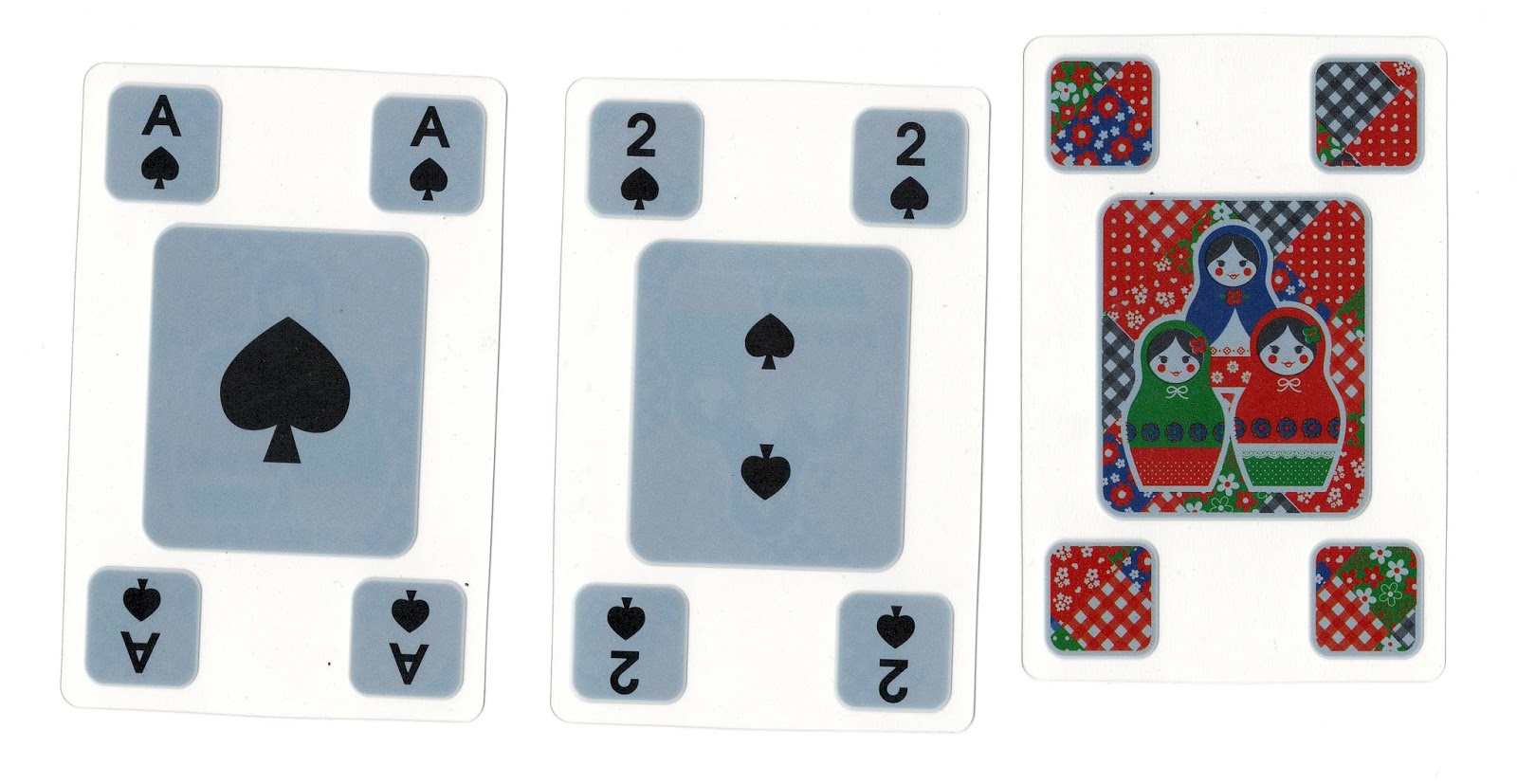
 The cards in this deck are slightly more complex than the one previously featured, Instead of simple indices, the pips are actually depicted on the cards. In turn there are also four indices to each card, instead of two. The back displays a charming design of Matryoshka
More cards are here depicted. they are overlaid with text, to show their transparency. Like the previous deck, the manufacturer has printed patches of opaque ink on the otherwise transparent cards. On these patches are printed the pips. 
Note the unusual arrangement of the pips, as well as the non-figurative court-cards. The Joker, meanwhile retains a human appearance 

Unfortunately, the opaque parts of the cards are not so opaque when strong light is shone against them. 

Saturday, 28 March 2015

"Playing cards No. 7728"

"Playing cards No. 7728", anon,  52+2c

The present deck of cards is most interesting. It was found in a small haberdashery shop in Singapore, where it lay forgotten, perhaps for nearly 30 years ( judging by the pictures on the cards), until the author purchased it from the somewhat bewildered shopkeeper.

The cards are of Chinese make ( as the inscription on the box tells us). The box itself displays an image of a embracing couple. Garish rainbow lettering informs us that it contains playing cards:


The playing cards themselves display similar images. Each and every one of them contains a couple in some state of embrace, or doing some activity together.
The images may have been magazine illustrations, or film  posters. Note the four of spades, where what appears to be the title of a magazine on the top. Also note the seven of hearts. In a somewhat inexplicable scene, a woman and a devil are seen together. \
Some cards  have an unusual horizontal format, as seen in the six of diamonds & seven of spades. In a particularly inexplicable moment, a couple are seen buying CDs

More cards from the set. Note the four of hearts. Upon closer inspection, the reflection on the sunglasses of the couple reveal a series of bingo balls

All the cards, and the box are printed on relatively poor quality card. The present deck appears to be a novelty deck. However, that deck of cards was sold along with a few other decks of similar make, one of which was a Oral-B  advertising deck. 

. I would most happily accept any information about possible sources for the pictures on the present deck. 


Thursday, 23 May 2013

Transparent playing cards ( 1 )

Transparent playing cards- anon- 52 + 2 c.

Transparent playing cards would surely seem to be somewhat of an outright impossibility- How would one play with a deck that would allow light to pass through it, & yet conceal what cards you are holding from your opponents?
  However, such cards are made, and the are perfectly playable. However, it can be said that the makers almost always "cheat" when designing the cards. Firstly, to make them transparent, they ay are printed on thin sheets of plastic.
the cards overlaid on text , showing their transparent nature

As you may observe from the above image, only a certan portion of the cards are transparent, the rest covered with a form of design which is opaque. It is on this design where the face side of the cards are printed on. In this case, the maker has decided to only print the indexes of the cards and nothing else.

a closeup of the above. Note the ornamented borders and centerpiece.

the cards held up to strong light


the same, held up the other way. Note the opaque ovals, on which the indexes are printed

However, at least in this instance, the maker has decided, presumedly for reasons of economy,  not to make the whole of the back design opaque, but only the small oval on which the indexes are printed. This causes the little ovals on which the indexes are printed to stand up when the cards are held up to strong light.

The cards in question were purchased from the Japanese discount store Daiso.  


Thursday, 2 May 2013

Circular playing cards I- house of marbles

"Circular playing cards/ Round playing cards" - House of marbles, 52c.+2

  Circular playing cards, although unusual, are by no means rare. The Indian Ganjifa cards are mostly circular in shape. This is doubtless due to the relative ease of making circles of regular shape than rectangles ( To make circles, one only needs a pair of dividers or compasses to trace the designs, whilst drawing rectangles calls for much work involving straightedges, which is wont to be inaccurate).
   However, as far as the west is concerned, circular playing cards are more often than not produced as novelties. This particular example is an English pattern. However, some modifications have been made to suit the format.


Spades
 
Notice that the court cards are repeated four times on each card, much like spokes on a wheel. In order for that to be achieved, the figures have to be stripped down a bit, thus making the king of spades look like four skittles!. The indexes are also repeated around the card in a similar fashion
The Joker displays a knight ( St, George?) slaying a dragon.


Diamonds
Note that although the courts have been repeated 4 times, the arrangement of the pips are as with a normal deck.
 
 
Clubs
Hearts.
The pips on the court cards seem to have been inverted


Friday, 8 March 2013

"Canasta special"- Modanio

"Canasta special"-Modanio-  54 x 3 cards

If you were to first see this deck of cards, without any introduction, one may be forgiven for thinking they were produced for a children's game- After all, how would you expect any serious game to be played with a deck which consists of pictures of fruit?
 
  However, it is not so. A serious game is indeed played with these cards, and it is Canasta. This becomes more apparent upon examining the deck's structure, and with a knowledge of how it is played.

 The subjects of a normal deck, have been replaced in this one with images of plants and animals. If one were to observe the indices of the deck. Firstly, the joker has an image of a copurnica ( D).  There are a pair of these cards, in each deck.


 Secondly, The 2s and aces are represented by a basket ( canasta in spanish) , and a pineapple.
( B, C) To reflect the black and red suits in a normal deck, Two of the cards have black frames, and two others have red ones.
  The red 3s of a normal deck(3, 3) now bear the image of a squirrel. The black 3s (3♣, 3♠,)  bear the image of a hound. There are only 2 of each card. ( A, J)
 The  4s, 5s, 6s and 7s have been replaced with images of berries. Like the pineapple and basket, their colour is reflected by that of their frame,  along with the colour of the fruit's stems and indices .
The 8s,  9s, 10s,  and the three court cards have been replaced with images of other kinds of fruit. Note the minature depictions of the fruit in the card's corner.

If you are somewhat confused, see http://en.wikipedia.org/wiki/Canasta