Showing posts with label novelty cards. Show all posts

Tuesday, 5 March 2019

Transparent playing cards (2)

Transparent Playing cards, Anon, 52+2c. 

Here is another example of Transparent playing cards.  See here for one previously featured, and for a fuller explanation of the cards. The author recalls that this deck ( as well as the previous one) was purchased in the Japanese discount store Daiso. 
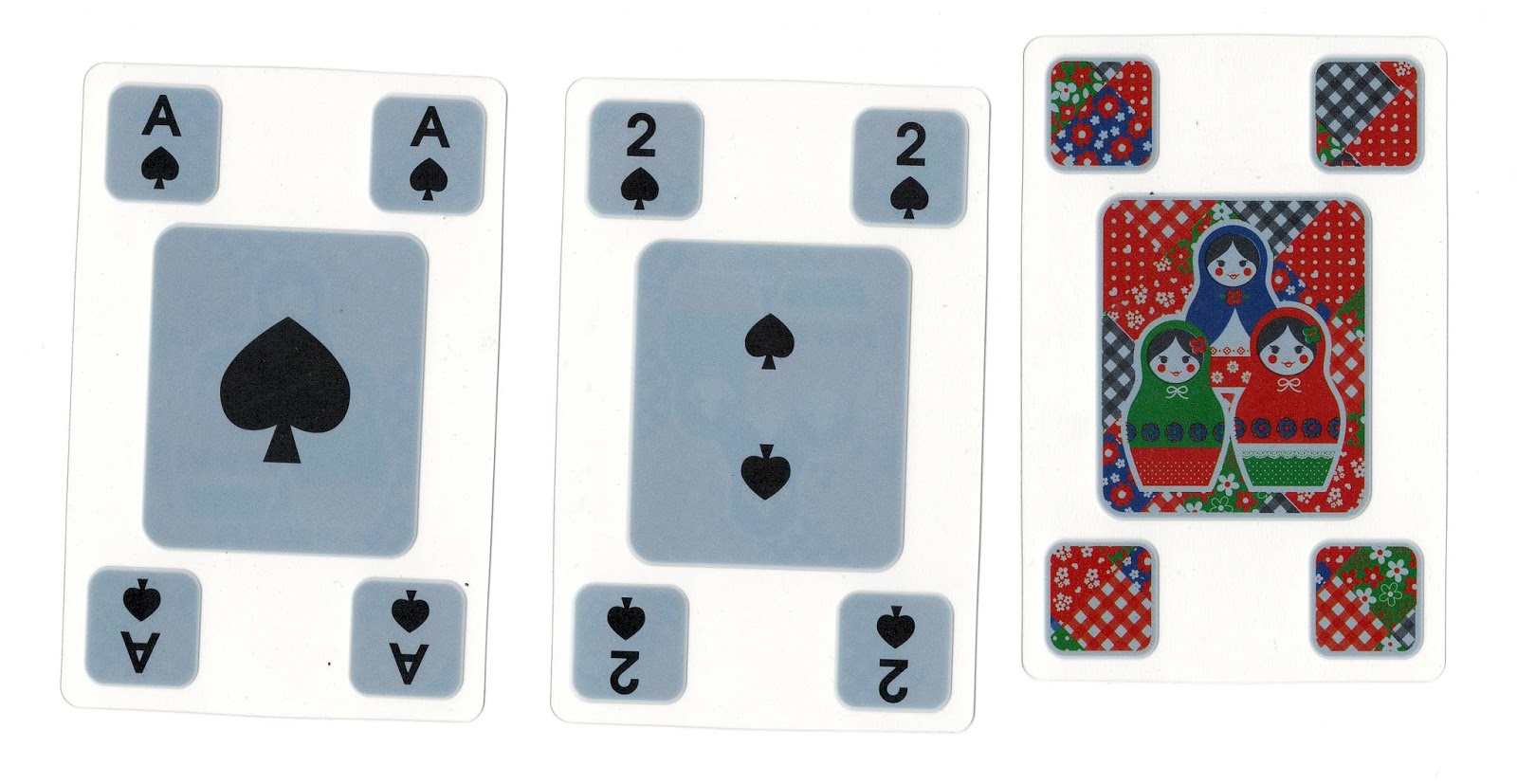
 The cards in this deck are slightly more complex than the one previously featured, Instead of simple indices, the pips are actually depicted on the cards. In turn there are also four indices to each card, instead of two. The back displays a charming design of Matryoshka
More cards are here depicted. they are overlaid with text, to show their transparency. Like the previous deck, the manufacturer has printed patches of opaque ink on the otherwise transparent cards. On these patches are printed the pips. 
Note the unusual arrangement of the pips, as well as the non-figurative court-cards. The Joker, meanwhile retains a human appearance 

Unfortunately, the opaque parts of the cards are not so opaque when strong light is shone against them. 

Wednesday, 5 June 2013

Crooked playing cards- US games systems

" The Crooked deck "- US games systems - 52c. + 3 jokers
We have here another of the species of novelty cards. These cards ( of which there are many makers, ) possess the feature of being cut into a curious shape
As you may see from the picture, not only are the cards themselves bent into this curious shape, but the images upon them are also distorted in this fashion. This is particularly prominent in the court cards.

One of the three jokers has the following inscription upon it. I find it worthy of being quoted here in whole:

THE CROOKED DECK

What some of our delighted customers have said about the CROOKED DECK...
"This is the best deal I've had in years..."Hot Hands Herbie, Poker Flats, Idaho
"Will add a new twist to your card parties..."
Mrs Zelda frobishier, Crooked creek, Pa.
"You will get ine fast shuffle from the CROOKED DECK ...'
Arnold freed, President, A.freed novelty inc.
Guarantee
In view of the age old truths that all glitterings are not rhinestones nor iron birds a cage make; then we cannot in all justification refund part or whole of purchase under any conditions which.
***
Rather surprisingly, given the odd shape, these cards are surprisingly easy to hold and grip, at least much easier than the circular decks.
 
The cards in hand


Circular playing cards-- Fournier

"Circular" -Fournier- 48c. + 2
 Another circular deck, this time from the Spanish maker Fournier. This deck is another example of the circular sort, save that it uses Spanish suits instead of the more common French ones.

 the suit of coins
as with the house of marbles deck, Fournier seems to have come up with more or less an identical solution to the placement of the pips and court figures on the deck. ( for a more conventional spanish deck, see http://anthonylesq.blogspot.sg/2011/11/castilian-pattern-by-fournier.html.)
However, unlike the house of marbles deck, which has 6 indexed around the circumference, this one has 4.
The suit of cups-- Again, much as coins.

Batons.

Swords: I find the placement of the swords , with their tips all pointing towards the center, vaguely threatening.
 
For another example of circular playing cards, see:
 

Thursday, 23 May 2013

Transparent playing cards ( 1 )

Transparent playing cards- anon- 52 + 2 c.

Transparent playing cards would surely seem to be somewhat of an outright impossibility- How would one play with a deck that would allow light to pass through it, & yet conceal what cards you are holding from your opponents?
  However, such cards are made, and the are perfectly playable. However, it can be said that the makers almost always "cheat" when designing the cards. Firstly, to make them transparent, they ay are printed on thin sheets of plastic.
the cards overlaid on text , showing their transparent nature

As you may observe from the above image, only a certan portion of the cards are transparent, the rest covered with a form of design which is opaque. It is on this design where the face side of the cards are printed on. In this case, the maker has decided to only print the indexes of the cards and nothing else.

a closeup of the above. Note the ornamented borders and centerpiece.

the cards held up to strong light


the same, held up the other way. Note the opaque ovals, on which the indexes are printed

However, at least in this instance, the maker has decided, presumedly for reasons of economy,  not to make the whole of the back design opaque, but only the small oval on which the indexes are printed. This causes the little ovals on which the indexes are printed to stand up when the cards are held up to strong light.

The cards in question were purchased from the Japanese discount store Daiso.  


Friday, 8 March 2013

"Canasta special"- Modanio

"Canasta special"-Modanio-  54 x 3 cards

If you were to first see this deck of cards, without any introduction, one may be forgiven for thinking they were produced for a children's game- After all, how would you expect any serious game to be played with a deck which consists of pictures of fruit?
 
  However, it is not so. A serious game is indeed played with these cards, and it is Canasta. This becomes more apparent upon examining the deck's structure, and with a knowledge of how it is played.

 The subjects of a normal deck, have been replaced in this one with images of plants and animals. If one were to observe the indices of the deck. Firstly, the joker has an image of a copurnica ( D).  There are a pair of these cards, in each deck.


 Secondly, The 2s and aces are represented by a basket ( canasta in spanish) , and a pineapple.
( B, C) To reflect the black and red suits in a normal deck, Two of the cards have black frames, and two others have red ones.
  The red 3s of a normal deck(3, 3) now bear the image of a squirrel. The black 3s (3♣, 3♠,)  bear the image of a hound. There are only 2 of each card. ( A, J)
 The  4s, 5s, 6s and 7s have been replaced with images of berries. Like the pineapple and basket, their colour is reflected by that of their frame,  along with the colour of the fruit's stems and indices .
The 8s,  9s, 10s,  and the three court cards have been replaced with images of other kinds of fruit. Note the minature depictions of the fruit in the card's corner.

If you are somewhat confused, see http://en.wikipedia.org/wiki/Canasta