Showing posts with label japan. Show all posts

Tuesday, 5 March 2019

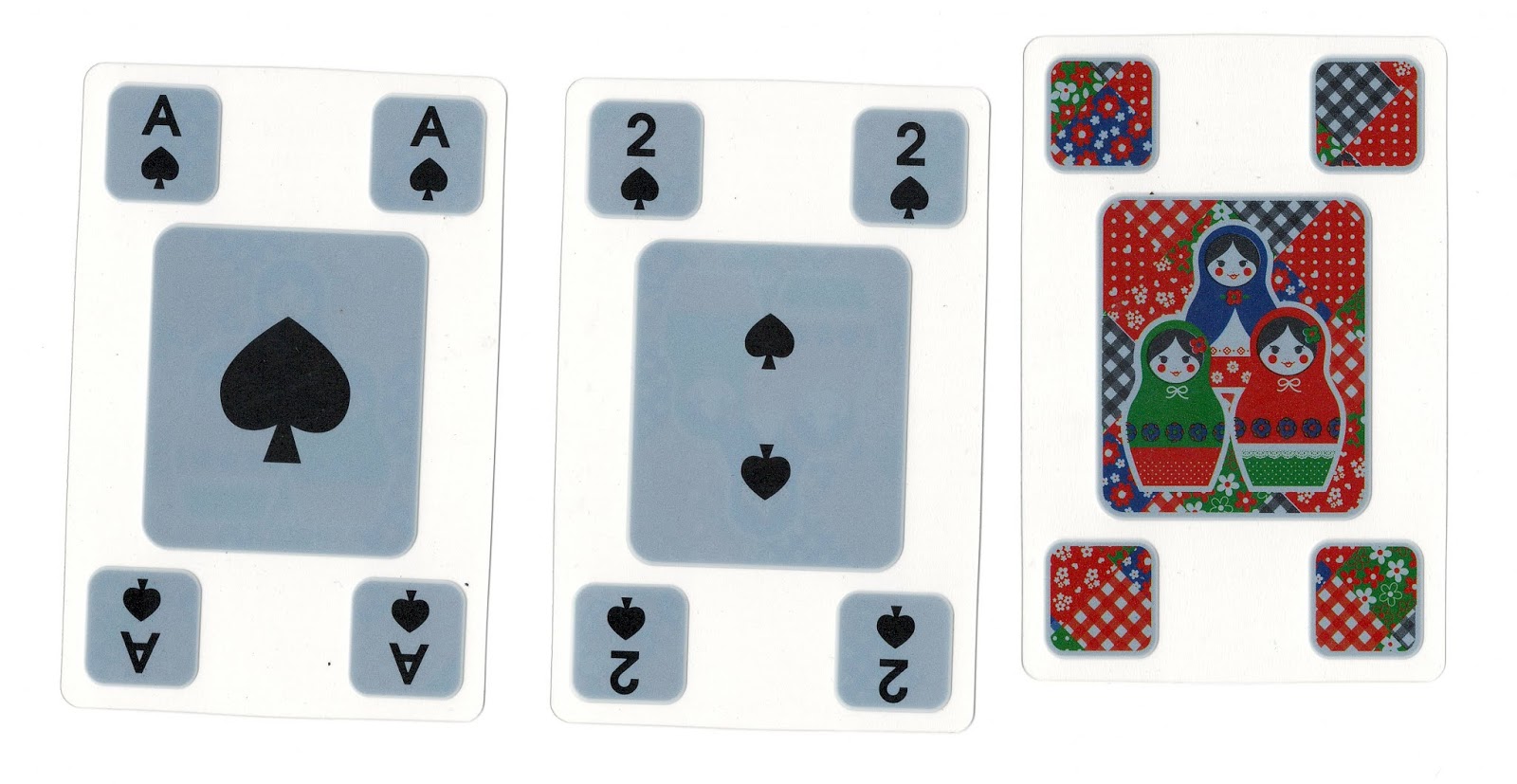
Transparent playing cards (2)

Transparent Playing cards, Anon, 52+2c. 

Here is another example of Transparent playing cards.  See here for one previously featured, and for a fuller explanation of the cards. The author recalls that this deck ( as well as the previous one) was purchased in the Japanese discount store Daiso. 

 The cards in this deck are slightly more complex than the one previously featured, Instead of simple indices, the pips are actually depicted on the cards. In turn there are also four indices to each card, instead of two. The back displays a charming design of Matryoshka
More cards are here depicted. they are overlaid with text, to show their transparency. Like the previous deck, the manufacturer has printed patches of opaque ink on the otherwise transparent cards. On these patches are printed the pips. 
Note the unusual arrangement of the pips, as well as the non-figurative court-cards. The Joker, meanwhile retains a human appearance 

Unfortunately, the opaque parts of the cards are not so opaque when strong light is shone against them. 

Wednesday, 10 October 2018

Kintokihana 金時花

金時花 Kintokihana, 48+1C. Oshi tengudo 大石天狗堂 

After a long interval, here is a deck from japan. We are told these cards come from Shikoku island in Japan. This deck was purchased around 5 years ago from a shop in Tokyo. The cards come in a elegant wooden box. The cards are also called Awabana 啊波花
Unlike the standard form of Hanafuda, the Kintokihana has the names of the months associated with each suit written on the card. The suit of "January", for instance has the words 一月“First month" written on the banner ( top row, 2nd from Left)  card. The remaining cards possess an encircled 一, meaning One. The same goes for the second row, showing suits from the second month-- 二月.

In other photographs of this pattern ( vide Andy Polett) the individual branches are picked out in white. In this example, the branches are picked out in silver ink. 
A translation of the short texts on the suit of January will be greatly appreciated. 

The Third [top row] and Fourth [bottom row] months.
The cards are very slightly curved along their width; you can see this in the 3rd month.
Unlike the other months, the "banner" card in the third month does not possess a numeral; rather a short text in japanese is shown, like in the "standard' hanafuda. 
Note The "Junk" cards in the third month. In this deck, the cherry blossoms are merely depicted. In the standard hanafuda, the cherry blossoms are shown growing from a branch. 

The Fifth and Sixth months. Some cards possess a stripe of silver across their width. This might be an aid to their identification. 

One of the major difficulties beginners have with hanafuda is knowing which card belongs to which suit. Unless you are familliar with Japanese plants, this is a hard task. It is further compounded by the same plant is depicted in different ways in the same suit. The numbers attached to the cards are thus an immense help, and it is hoped makers of Hanafuda would make more cards with this feature. 

The Seventh [top row] and Eighth[bottom row] months. 

On the two "Junk" cards of the 8th month, [ 2nd and 3rd from left, bottom] Japanese texts are seen. I would be most glad if anyone told me what they say. Note the blades of grass picked out in silver, on two of the cards in the Eighth month 
The Ninth [top] and Tenth months[bottom].   Note the horizontal bands of silver on some of the cards 

The suit of Eleventh (Top row) and Twelth months. Notably, the twelfth month is unumbered. 
To the far left we see the the extra card. It depicts Kintaro, a renowned Japanese warrior.

Thursday, 23 May 2013

Transparent playing cards ( 1 )

Transparent playing cards- anon- 52 + 2 c.

Transparent playing cards would surely seem to be somewhat of an outright impossibility- How would one play with a deck that would allow light to pass through it, & yet conceal what cards you are holding from your opponents?
  However, such cards are made, and the are perfectly playable. However, it can be said that the makers almost always "cheat" when designing the cards. Firstly, to make them transparent, they ay are printed on thin sheets of plastic.
the cards overlaid on text , showing their transparent nature

As you may observe from the above image, only a certan portion of the cards are transparent, the rest covered with a form of design which is opaque. It is on this design where the face side of the cards are printed on. In this case, the maker has decided to only print the indexes of the cards and nothing else.

a closeup of the above. Note the ornamented borders and centerpiece.

the cards held up to strong light


the same, held up the other way. Note the opaque ovals, on which the indexes are printed

However, at least in this instance, the maker has decided, presumedly for reasons of economy,  not to make the whole of the back design opaque, but only the small oval on which the indexes are printed. This causes the little ovals on which the indexes are printed to stand up when the cards are held up to strong light.

The cards in question were purchased from the Japanese discount store Daiso.  


Wednesday, 8 May 2013

Irinokichi ( 入ノ 吉) - Nintendo

 
"入ノ 吉 / 入の 吉 " ( Irinokichi) , Nintendo - 48c. + Onifuda + blank 
 
    Another Kabu deck, with the rather pleasing name of "coming-in-luck"  this particular pattern differs from the others by several features.
Firstly, this deck uses the suit of batons, much like the Kabufuda . In fact, one could imagine that the kabufuda evolved from just such a deck, as the pip cards are almost identical.
  Secondly, unlike the other decks, this deck has all 3 courts. However, it is interesting to note that the knave has a rather realistic depiction of a person, unlike the knight and king, which are abstract forms

 
Key to Positions of cards in picture below:
Top row : 7, 8, 9, 10, [ knave] , [ knight] , [king]
Bottom row: 1, 2, 3, 4, 5, 6
 
 The pip cards.
 

from L-R, onifuda, special ace, special 4
Note the fact that the silver overprints on the cards are nearly transparent with age. The red on the onifuda has streaks on it, perhaps indicative of stencilling?
 

Tuesday, 12 February 2013

Daiini - Nintendo

Daiini ( 大二) , Nintendo, 40c. + Oni-fuda + blank

 Again, we have another Kabu deck, Daiini- "Big Two" . The structure of this dck is not very different from the other decks of it's family, but several features make it worthy of mention:
1- The court card and ace have now been further abstracted, to such a point that they now are a few unrecognisable blobs of colour, only ( vaguely) retaining their original shape . It appears that I have displayed the knave ( 1st image, 1st row, 5th from left) upside down, but the design is so abstract, IMO, it makes little difference!
2- The 4s have a little circle in the middle of their 4 pips; It contains the characters "大二" - Daiini- thus spelling out the pattern's name. The deuces ( 2s) reflect this, as their pips are rather large when compared with the others

( top row) - 6, 7 , 8, 9, ( Knave)
( bottom row) ( ace) , 2, 3, 4, 5
L-R - Onifuda, special ace, special 3, special 4
The "special" ace, 3, and 4. are not very far removed from other such decks , save the use of gold instead of silver ink. Note the Onifuda. The demon's eyes are framed in gold ink, thus giving it the rather comical appearence of wearing spectacles!
The knave displayed one way, and then another. I leave it to you to decide which card is " Right side Up"

Mahjong- Hanayama

"カード麻雀"(Mahjong)- Hanayama, 139 + 4 C.

The Japanese game of mahjong differs slightly from the versions played in China, HK, and elsewhere. For starters, the game uses only 136 tiles, instead of the 144 or more used elsewhere. These variations are reflected in a pretty little set from that country.
 The set presented below is a complete fac-similie of a japanese mahjong set, reproduced on paper. The cards here are closer to the size of mahjong tiles than normal playing cards ( they are only 3 x 5 cm ), and as a result, the set also comes with four card "racks",  on which the cards may be held in the game

Besides, the basic structure of the deck is more or less similar to the other examples shown elsewhere on this site ( compare http://anthonylesq.blogspot.sg/2012/09/mahjong-ii-kr-brand.html)


The suit of coins.
Note the miniature depeictions of the cards used as indices placed in the corners of the cards.  Also note that colour black, or rather, a very dark indigo blue, replaces the brilliant blue of other sets

The suit of bamboos-
Note the one of bamboos ( 1st row, 1st from left) The bird depicted here is much more complex than that of the previous examples, resembling a peacock, rather than an abstract jumble of lines resempling a parrot


the suit of 萬
Again, not much removed from the other examples shown

~Other cards, and the back design~
The Dragons  ( A ) dislpay small variants from the chinese. For starters, the "發" is written somewhat differntly from the chinese. Secondly, the "白板" here is completely blank, without the "frame" in other examples. However, the makers printed, in a very faint grey , the word 白 on the card ( barely visible in the above img. ), perhaps to prevent it from being mistaken for a spare card. 

The Winds ( B) are relatively unexcaptional.

  Here is where the differences between Japanese mahjong and the Chinese versions become apparent. Firstly, There are no flowers, as the japanese game usually does not use them. However, in some variants, three cards, known as "red fives" are used. ( C) . They function as special bonuses.
as for D, I know not what it does ( any Trasnlation appreceated) , and E is a yakitori marker- A piece of scoring appartus used in the game.


Monday, 7 January 2013

Tehonbiki

The game of tehonbiki is certanly a most curious one, and one with a very shady reputation in Japan. However, if we are to understand the game ,  we must first explain the perculiar apparatus used in playing it. Two decks of cards are used, the "harifuda" and the "mamefuda".

"Mamefuda" ( 豆札) , "大將軍" ,  48c. ( 6 x 8)  +  blank card
The whole series of Mamefuda, 1-6 ( L to R)

The deck of mamefuda consists of a series of 6 cards, numbered from 1-6 , repeated ( at least in the present example) eight times, to yeild a deck of 48 cards. As the cardstock is pretty thick, when the cards are stacked up, the stack is 7.5 centimeters high. However,  the whole deck of cards isnt used in the game, but only one series of such cards.
 The cards have several curious features. For one, the ce resembles a dragon. This is significant as the oldest japanese cards feature such an animal on the aces. Whilst in most other decks, this animal has been transformed into an unintelligable squiggle, here is remains more or less recogniable. Furthermore, the cards are much, much smaller than the usual Japanese cards. The cards are only 2.5 by 4.5cm. That makes them slightly smaller than a man's thumb. Otherwise, the cards more or less resemble the suit of coins in other japanese decks. For example, the 2s are framed, as well as the central pip of the 5.

The next deck of cards used are the "harifuda"

"Harifuda" (張札) , "大將軍" , 42c. ( 7 x 6)
one series of harifuda. 1 to 6 ( L-R)

This deck also follows the same structure as the mamefuda, comprising of a series of six subjects repeated several times. However, this time, the values of the cards are given by a series of stylized chinese numbers. If you compare the above cards with the chinese numbers from 1 to 6, as below, the connection is clear:

一 二 三 四 五 六

Another curious feature is the red lines that appear on some of the cards. The one has a red line, the 2 and 3 have two and three lines respectivley, the four has none, the five has a red semicircle on the top and bottom edges of the cards, and the six has similar deocration in each of it's corners. I guess that this decoaration functioned as a form of index for the cards
 Here is an old uncut sheet of harifuda. Notice that the odd numbers here are printed in red, and the even numbers black. Also note that the six has the maker's name written on a banner between it's "legs"
Another piece of apparatus used is the memoku, or 目木. Rather confusingly they are also refered to as the "Mefuda". These are blocks of wood with the numbers of the harifuda inscribed on them. They are placed in numerical order before the banker, and are used to indicate his preference

***************************
 My understanding of the rules cheifly comes from Andy Polett's marvellous website
(http://l-pollett.tripod.com/cards70.htm) , and the actions of the propreitor of the cardshop from which I bought the cards from.

 The game of tehonbiki is certanly a most curious game, and can be said to be little more than a game of dice transferred to cards. This fact becomse more obvious when you consider the structure of the deck ( 1 to 6, as per dice) , and the manner in which it is played.
 
 The dealer first takes one series of mamefuda, and shuffles the six cards. He does so hidden from view, either in his pocket or with his hands behind his back, the small size of the mamefuda helping him in the process. Once it has been shuffled, a card is withdrawn , and placed under a piece of cloth. He does not look at its value.
The players now attempt to guess the value of the card that the bank has chosen. The player use the harifuda to indicate which card they bet is the one under the cloth . They do so by arranging the harifuda in various ways, and by these arrangements, the bets are made. The system of betting is too complicated to be shown here in detail, but the pariculars may be found on Mr. Polett's website.
 The bank then makes his own preference, by placing one of the Memoku to the right of the row.
The cloth is then uncovered, and the bets paid out.
 I am also told that the game is indeed in very ill repute, but rather surprisingly, one may find examples of these decks ( or at least the Harifuda) more easily than mekuri decks, or indeed kabufuda. I belive that some of these decks may have been ordered in error, as the spelling of Harifuda and Hanafuda is so close.


Thursday, 3 January 2013

Kabu cards- "Komaru" ( Nintendo)

Komaru (小丸)- Nintendo 40c. + onifuda + spare
We have another deck of kabu cards, this one known as the "Komaru" - small circle. This deck is identical on structure to the Mefuda previously mentioned, but the differig illustations are the point of interest here. Whilst the mefuda look like the the work of a child or a very sloppy colourer, this deck is less abstract, and the circles more... circular.
 Here the ace retains a more or less serpentine form, as as opposed to the simple black card with 2 lines of the mefuda. However, the court card here is less abstract than the mefua, bearing the vague appearence of a scowling soldier wearing a hat .The 2s are also encased in a frame, along with the central pip of the 5s.
 Again, one of the aces, threes and fours recive special decoration.
-Komaru-
Key:
1st row ( L-R) 6, 7, 8, 9, ( knave)
2nd row ( L-R)  (ace),2, 3,4, 5,
"Special cards" 4 of batons ( replaces one of the 4s), ace, and 3( L-R)

Kabu cards- "Mefuda" ( Nintendo)

Mefuda (目札 )-Nintendo, , 40c. + onifuda and blank
 We Now come to another species of japanese playing cards, known as the "Kabu"cards. These cards are basically single suited decks. That is, the deck comprises of one suit ( Usually coins or batons) repeated 4 times. There are usually 10 ranks in each suit, to give a deck of 40 cards.
 The particular deck shown here is known as the "mefuda", "( Eye-cards) , and gives a good introduction to this species of cards. The suit used here is the suit of coins, here corrupted to blobs of black paint., from 1 to 9. The tenth card is the Knave (or perhaps a cavalier in this case, as it has 4 legs), presenting the appearence of a few blobs of colour preched upon four legs  
 There are 3 identical series of these 9 cards. However, there is a fourth  series, in which some of the ranks are secorated with silver overprints. Usually the ace, trey (3) and the four of that suit recive that decoration. However, In decks like this one which use the suit of coins, the four in the special suit tends to be replaced, rather inexplicably, by a four of batons.
 Another curious ( and rather delightful) feature is the inscription on the duces (2s) treys (3s) and fours of each suit, along with the special ace. The inscription reads "金錢不用"- Use no gold or money"*, A rather splendid prohibition against gambling

-Mefuda-
1st row ( L-R)-- 6,7, 8,9,(knave) 
2nd row (L-R)-- (Ace), 2, 3, 4, 5
3rd row( L-R)--- Onifuda, Special ace, special 3,special 4

* Or, if you were to make a rhyme of it
"Gentle gamster, I pray that ye
use no gold or silver with me "

Wednesday, 19 December 2012

Kurofuda - Nintendo

"Kurofuda" ( 黑札) - Nintendo, 48c. + "onifuda" + Blank

   We now come to the second type of mekuri karuta, the "Kurofuda", or "black cards" . Looking at the cards, it is easy to see why they got the nickname. The features of the deck are almost completely obscured by large areas of black or red paint; so much so that the only reliable method of identifying the the cards is by the shape of the blobs of paint.( Unlike the akahachi, where the features of the deck are for the most part, just blobs of paint, this deck has printed outlines, which are painted over with blobs of paint)
  Sylvia Mann states that this deck is the closest deck to the portugese originals. In some ways, this is correct. When one looks closely at the cards. you can see outlines of faces, &c. which have been covered by the black paint ( if you look carefully, you can see them in the images below)  . These faces do indeed reseble actual human figures ( unlike the abstract forms of the akahachi)
Another curious feature of the deck is the lack of silver overprints.

Compare: akahachi- http://anthonylesq.blogspot.sg/2012/12/akahachi-nintendo.html
Key to position of cards:
top row- 7, 8,  9,  (Knave),  ( Cavalier), (King)
Bottom row---Ace, 2, 3, 4, 5, 6


Swords or isu
As you can see, the colour in these images is applied more or less iin total disregard to the outlines of the figures. Note the shape of the swords. In the "Akahachi", the swords are just red lines, But here, they are more realisticaly dipicted.Also note the bird on the 2 of swords. You can also see the legs & lower half of the king's body.


Hau or batons
As with the akahachi, the main difference between the swords & batons is the colouring. Note the cavalier. The legs of his mount are visible, untouched by paint.

Ôru, or coins
The pips in this suit still remarkably look like it's european counterpart ( The star-like design in particular). If you look closely, the three court figures hold a starlike coin.
Koppu or cups
The cups in this suit are rounder and more bulbous than that of the Akahachi. You can see the lower part of the knave's body.

Compare: Akahachi


Friday, 21 September 2012

Mahjong - III - "游の屋"

Mahjong- 144c. "游の屋"

 We have a rather curious case here. Aldough the cards to all appearences the cards look chinese, the name of the maker contains  "の"- a japanese word, meaning "of". However, it is known that in taiwan, this character is sometimes used to replace 的, having an identical meaning, to give the brand a more exotic feel. Hence, if I did not err in the transcription, the maker's name is "house of games"
Another curious feature is the colour scheme. This deck replaces blue with black, and the 2s, 3s and 5s of coins are only printed in either red or green, onitting black/blue entirely

                                                                             Coins.  
bamboos.

萬- wan or 10000s

The winds ( top, with "南"inverted) & dragons ( bottom) Again, black replaces blue

Some flowers. Note the different, more stylized carving

Sunday, 1 January 2012

D'Israeli on gaming

In 1791, Issac D'Israeli ( father to Benjamin Disraeli, the prime minister) published a book called "curiosities of literature". This book proved so popular ( it was a kind of Misclaney ) that he added two more volumes, and later wrote a further three volumes in a "new series"

In the first volume of series 1, D'Israeli wrote a little section on "Gaming".
In it he informs us that.....
Evidently, addiction to gambling is as strong as in 1791 as it is today.

And I wish a happy new year to all my Dear readers.

Sunday, 13 November 2011

kabufuda ( nintendo)

kabufuda by nintendo. 40 cards + 1 spare.

The following deck is but the last survivor of one of the most amzing journeys in the history of cards: the introduction of cards into japan. as the story is quite long, I shall post it seperately. http://anthonylesq.blogspot.com/2011/11/how-cards-came-to-japan.html
Anyway, the important bit is this: When the portugese came to japan, the locals copied, and played with the portugese cards with gusto, developong the their own local versions. However, at some period of time, one bright spark decided to repeat one suit of the four-suited deck  four times,  for use with counting games, similar to baccarat. Some decks used the suit of coins , and others like the kabufuda here, the suit of batons.

The deck you see below consists of 4 series of 10 subjects, viz: ace-9 & a jack. ,  ( see caption on 1st pic)
in one of theese series, however, the ace and the 4 are more elaborate than the other 3 ( see second pic)
the game that is played with this deck is much like baccarat.
top , R-L  ace, 2,3,4,5
bottom , R-L - 6,7,8,9, knave/ jack ( countas as 10)

the more elacorate ace ( far right) , and four ( middle), with what appears to be a medal on it.
the wrapper ( with a pic of Napoleon ) is on the fal left.

how cards came to japan

In the 16thc, portugese sailors came to japan, bringing along with them many new things, like guns,buttons, and more importantly, playing cards.(the cards were an very idosyncratic latin-suited pattern, the most notable feature of which was the fact that dragons or sea-serpents wound themselves around the aces)

The japanese copied this strange new form of entertainment with gusto, down to the very names of the suits, and yes, the dragons. However, with frequent copying, the dragons ( and the court cards too) became more & more stylized, till the extent that they were transformed to splodges or squiggles , what little detail obscured under paint.

later, someone had the bright isea of repeating one suit of the cards 4 times. in the case of the below deck it was the suit of batons, nut others used the suit of coins.
anyway, all the patterns I mentioned above, including the portugese patern, are long extinct. al that is left is this deck.