Showing posts with label joker. Show all posts

Sunday, 28 June 2020

Mah Jongg Cards:

"Mah Jong playing cards" Happiness, 148c. 
麻雀纸牌, 囍, 148 副
The present deck of cards is a deck of cards for playing the game of Mahjong. Cards of this make have evidently been around for a long time,  This post by the knowledgable Tom Sloper https://www.sloperama.com/mjfaq/cards.htm - perhaps well over a decade old now- shows decks of Mahjong Cards that are very similar in design to this present deck. The present dc

Decks of mahjong playing cards have been featured previously in this blog. (See This, This, This ). In any case the deck featured here seems pretty rare now; Most decks are of the wider, 'poker' format that the previously featured decks belong to. 


The Suit of Coins. The Maker's Name (happiness)囍  is found in the middle of each card

As you can see, the cards here resemble physical mahjong tiles,  One unique feature of these cards is the use of Arabic numbers in the indices. This feature is never found in actual mahjong tilesets, save those intended for export. We presume these cards were also made for export too. 

The Suit of bamboos 

In the above-mentioned post by Tom Sloper, he advises people to purchase several decks of cards, as they are inevitably misprinted. This does not appear to be true any more. Aside from the odd smudge, the cards are well-printed on nice smooth cardboard. The problems of length and misalignment are no longer evident. 


The Suit of Myriads. 

Nonetheless, these Cards, or Kards (as Sloper calls them to avoid confusion with a piece of equipment used in the American game of mahjong) are still fairly cheap.  The author purchased a ten such decks for 20 Chinese Yuan, which in 2020 is about 2USD. Evidently Mr. Sloper's supplier was making a huge profit off these decks. 


The 'Honours'.  The Three cards on the left are what are called in the west the "Dragons". Rather curiously their indices do not display the conventional western names of as Red, White and Green dragon (Left to right) , but rather romanisations of their Chinese names, viz:
中 = Chung (now usually spelt Zhong)
白= Pai (Now usually spelt Bai)
發 = Fa  (Still spelt Fa)
Even more interestingly, the four 'wind' cards ( the group in the middle,)are annotated in english, to whit, North, South, East and West. The card labelled "K" is a Joker; The Chinese character 皇 on it signifies "Emperor" or "King", hence the index. 


The flowers

Readers should note that despite having 148 cards, the present deck cannot be used to play Singaporean/Malaysian -style Mahjong. The Singaporean deck has 12 flowers instead of the 8 here; The extra 4 depict a cat, a rat, a chicken and a centipede respectively. 


The Box


Thursday, 10 October 2019

Character cards

Suliao Zipai (Plastic Character cards), Xin Bin ,  80+1c,
 塑料字牌, 鑫宾 80+1副

Yet another of the character cards. Although not explicitly known as such, the cards are probably manufactured to play the game 'Two-Seven-Ten", like one featured earlier in this blog.


The suit of large characters  When compared to other examples, the characters are printed in a font that is almost identical to normal print. 


The small suit.
The card marked A is 底換-- Di Huan.-- "Bottom/ Switch" 
Isao Umebayashi's article on the game Two-Ten-Seven ( The Playing-Card volume XXV No 4.), shows an image of a similar deck, which had a card with the same words (底/換) as the present card, except the words were written on opposite ends of the card. 
Mr. Umebayashi and his translator (George Hatton ) could not find the mandarin pronunciations of the characters. They had to make do with the Japanese and Cantonese pronunciations. 
The author remedies the defect below: 

 底=Soko (Japanese) = Tai (Cantonese)= Di (Mandarin)= Bottom
換= Kan (Japanese) = Oon (Cantonese) = Huan (Mandarin) = Switch


Cards that possess the extra bottom/switch card now seem to be quite rare. 


Tuesday, 5 March 2019

Transparent playing cards (2)

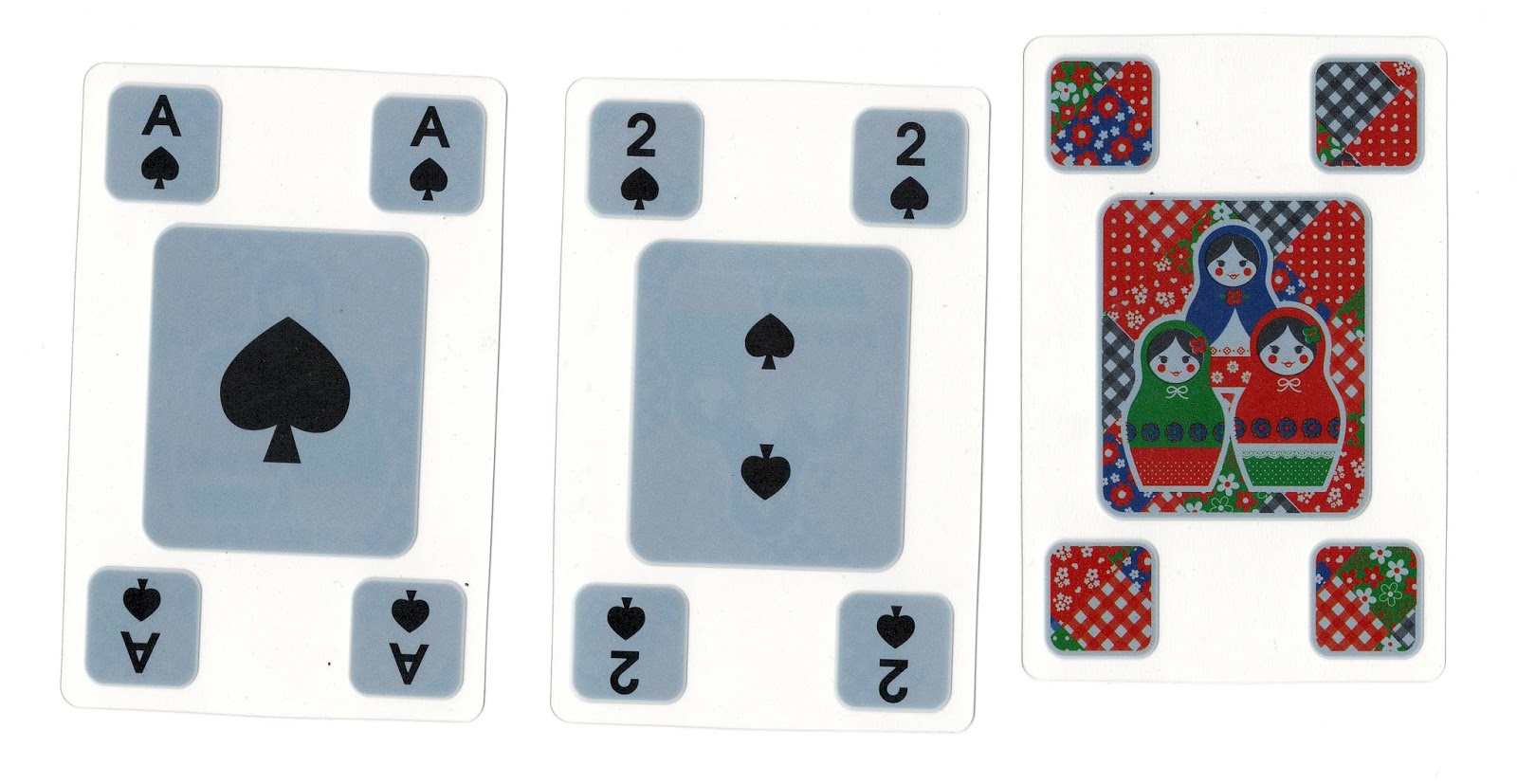
Transparent Playing cards, Anon, 52+2c. 

Here is another example of Transparent playing cards.  See here for one previously featured, and for a fuller explanation of the cards. The author recalls that this deck ( as well as the previous one) was purchased in the Japanese discount store Daiso. 

 The cards in this deck are slightly more complex than the one previously featured, Instead of simple indices, the pips are actually depicted on the cards. In turn there are also four indices to each card, instead of two. The back displays a charming design of Matryoshka
More cards are here depicted. they are overlaid with text, to show their transparency. Like the previous deck, the manufacturer has printed patches of opaque ink on the otherwise transparent cards. On these patches are printed the pips. 
Note the unusual arrangement of the pips, as well as the non-figurative court-cards. The Joker, meanwhile retains a human appearance 

Unfortunately, the opaque parts of the cards are not so opaque when strong light is shone against them. 

Friday, 15 September 2017

'Crown" playing cards

' Crown' playing cards. 52c+2

These cards were purchased in Singapore around 2010. They represent the extreme end of price in playing-card manufacture, each deck vending for $1.50 Singapore dollars. Despite ( Or because) of their low cost, they show some interesting features.
 First, they are made of plastic. Granted, this plastic very flimsy, and discolored, but the choice of material is not one would expect from cards thus cheap


The suits of Spades and clubs. The pattern is printed in three colours, for reasons of economy. Note the Queen of spades, whose printing is much lighter than the rest. The Joker is similar to the ones printed by Piatnik 

Hearts and Diamonds. Note the symbol on the K. of Diamond's breast. Might this be the maker's mark?

But, the real curiosity of these decks are their backs. They came in a bewildering variety of shades and varieties. Perhaps restricted by the convention of the faces, the printers decided to exercise their creativity on the other side of the cards. 

. Here are two eye-catching examples. The one on the right strikes me as an unusual choice of design for deck. 

.
Two more examples. The one on the Left is quite literally a "Bicycle" deck. The one on the right was also printed in other colours.

Friday, 17 June 2016

"Black Jack 21"

"Black Jack 21", Wetecs Sdn Bhd, 52+4

This deck represents one of the delights of card-collecting. Finding the unusual in unexpected places.
For all appearances this deck is utterly unremarkable. It is, like many tens of thousands, nay, millions of decks that grace the shelves of small shops all across the world, It is that tried-and-tested double-faced 52-card Anglo-American pattern. However, it is certain small details that catch the eye, and make even the most humble deck stand out.

The spades and clubs. Note the crown, delicately rendered in colour pencils that graces the ace of spades. We are told that the cards are made by, a Malaysian company; Wetecs Sdn Bhd. 

The Diamonds and hearts. At this point I should note that the back is an imitation of USPCs famous "Aladdin" cards. 
However, it is the jokers that the real charm of the deck lies. Instead of the usual jesters, we have four droll caricatures of a criminal being stuck in various circumstances. They are delicately rendered in colour pencil. The artist has taken care to incorporate playing cards into each of the scenes. 

Such are the delights of card-collecting, The little gems in unexpected places. 


Thursday, 10 March 2016

Dutch Scenic aces 4 :Hooghoudt

"Hooghoudt: 56 Geplastificeerde Speelkarten". Cartamundi, 52c+2

The following deck is a pleasing advertising deck made by the distillers Hooghoudt. Most advertising decks carry the advertisements on the back only. However, the traditional Dutch scenic aces offer additional possibilities. Instead of the traditional "views of the world", the scenic aces here display views around the company's brewery.

Spades and clubs. This is the same "Dutch pattern" as seen in the Prima speelkaarten 1410, but admittedly more colourful. 

Hearts and Diamonds. Note the rather tasteful use of purple in the Queen of diamond's dress. 

The Scenic aces. Unlike the other decks ( as Here and Here), the Hooghoudt deck is illustrated using photographs-- a suitable modernization. 

The other side of the aces. 

One of the Jokers and the back. Although the title of the deck says "56 cards" ( implying 4 jokers) only 2 are present in the deck. They are the standard Cartamundi Jokers. 
The backs advertise Hooghoudt Beerenberg , a sort of spiced gin. The alcoholically inclined reader may find the following link useful:http://www.hooghoudt.com/ . Be prepared to enter your date of birth. 

Friday, 8 March 2013

"Canasta special"- Modanio

"Canasta special"-Modanio-  54 x 3 cards

If you were to first see this deck of cards, without any introduction, one may be forgiven for thinking they were produced for a children's game- After all, how would you expect any serious game to be played with a deck which consists of pictures of fruit?
 
  However, it is not so. A serious game is indeed played with these cards, and it is Canasta. This becomes more apparent upon examining the deck's structure, and with a knowledge of how it is played.

 The subjects of a normal deck, have been replaced in this one with images of plants and animals. If one were to observe the indices of the deck. Firstly, the joker has an image of a copurnica ( D).  There are a pair of these cards, in each deck.


 Secondly, The 2s and aces are represented by a basket ( canasta in spanish) , and a pineapple.
( B, C) To reflect the black and red suits in a normal deck, Two of the cards have black frames, and two others have red ones.
  The red 3s of a normal deck(3, 3) now bear the image of a squirrel. The black 3s (3♣, 3♠,)  bear the image of a hound. There are only 2 of each card. ( A, J)
 The  4s, 5s, 6s and 7s have been replaced with images of berries. Like the pineapple and basket, their colour is reflected by that of their frame,  along with the colour of the fruit's stems and indices .
The 8s,  9s, 10s,  and the three court cards have been replaced with images of other kinds of fruit. Note the minature depictions of the fruit in the card's corner.

If you are somewhat confused, see http://en.wikipedia.org/wiki/Canasta

Thursday, 15 March 2012

The international pattern V- "Stud" ( USPCC)

"Stud" ( USPCC)- 52c. + 2 jokers
Another american deck!. This deck is primarily distributed through the Walgreens pharmacies in the US. However, you may obtain some decks online from retailers of cards.
The deck's smoothness and ease of shuffling is the subject of legend, but more interesting features interest us here;
I -The design of the courts is markedly diffrent from all the other makers, being slightly more ornate.
II- Again, there are indexes in only 2 corners.
Compare; http://anthonylesq.blogspot.com/2012/03/international-pattern-part-i.html


Wednesday, 14 March 2012

The international pattern- III- Ramblers ( USPCC)

In the third part of this series, We shall now investigate the cards as they are used in America.

"Ramblers No. 23"- (USPCC) 52c. + 2 jokers.
 The deck of cards here varies substantially from the Waddingtons deck ( see http://anthonylesq.blogspot.com/2012/03/international-pattern-part-i.html).
I-  the cards use the wider, "poker"format ( 6.7 x 8.7 cm) , which is used by almost all the US card makers
II the designs are somewhat simpler than the waddingtons ones, but still use the same four colours.
III the indexes are in only 2 corners.
  It would be perhaps of interes to note that the courts used in this deck are identical to those used in the more famous "bicycle"decks.

Monday, 12 March 2012

The International pattern part I - waddingtons

It can be said that the international pattern is the most commonly used type of playing card today. The pattern itself is a version of the cards that were [and still are] used in england today.
In this article, and those that follow it, I shall showcase some versions of this pattern, and compare them.
The first deck , (which we shall compre all the other decks with) is made by Waddingtons.

"Number 1" ( waddingtons) - 52c. + 2 jokers

The following deck very much speaks for itself. However, note the following features;
I - the cards are in the slim "bridge: format - ( 5.8 x 8.8 cm) , as opposed to the slightly wider "poker"format - ( 6.7 x 8.7 cm)
II- the cards are printed in 4 colors- Blue, Red, Yellow, and Black.
III-there are indexes in all 4 corners.


Thursday, 2 February 2012

"Jie mi pu ke"

"Jie mi pu ke" ( 解密撲克)[ mystery solving poker"] -- "卡之王" ( "kazhiwang" , "king of cards") 54c.

 The following children's deck is a testament to Chinese ingenuity. Aldough the deck is printed on poor quality cardboard, and the printing is much off register, the maker managed to squeze six seperate decks into the space of a patience sized one .
as you may see, the majority of the card is taken up by a depiction of a superhero . however, notice that, beside the index signs, there are a pair of dice values.  there is also a circle, in which contains one ofthe symbols for "rock-paper-scissors".
to illustrate these features [and more] more clearly, I have labelled them bellow:

1- the standard index-signs
2- a pair of dice-values. evidently used as a substitute for dice
3- "rock paper scissors" symbols. - as above
4-"defence power"  - evidently used for a sort of comparing game
5- "attack power" - see above
6- a series of stars, each card hsving a diffrent number. Perhaps used for a comparing game?

The box that contains the cards, bears the legend:
" Jie mi pu ke must not be used for gambling"
This is all for a very good reason, as the cards come supplied with a little plastic sheet. if you place the backs of the cards to the plastic sheet, their value may be discerned.

note the faint "3 ❤"


Tuesday, 31 January 2012

"canasta"( modanio)

"Canasta" ( modanio ), 162 c. ( 54 cards x 3 )
This curious variation of the international pattern is made for only one thing in mind, that is, the playing of the game of Canasta.
As some of my readers will know, in canasta,  only the colour of the suit  counts ( that is, there is no distinction made between hearts & diamonds nor spades or clubs) . Therefore, the ingenious italians have made a special deck expressedly for this game, with red or black dots replacing the suits.

As in Italy, the game of canasta is played with 3 decks of cards, this "pattern" comes only in 162 card sets, with 3 copies of each card.

Note that the courts used in each "suit"  are identical. 


Monday, 19 December 2011

"No. 32" ( fournier)

"No. 32" ( fournier) , 48c. + 2 jokers and 1 spare.
This deck is of the Catalan pattern, which is a reworked version of the spanish national pattern.  Aldough it is rarely used in spain, it is quite commonly used in latin america.


Thursday, 6 October 2011

russian playing cards

Russian playing cards, c. 1950
54 cards, 2 jokers, (identical)
I would greatly appreceate if anyone would translate the inscriptions on the cards

                                                                       
                                                         Box-


compare this with a deck from 2010