Showing posts with label international pattern. Show all posts

Thursday, 15 November 2018

Rummy Tiles

[Rummy Tiles] 104+8 C, Singapore.

In Singapore, mahjong shops sell a kind of gaming-tile. The tiles are called 'Rummy', after the game that they are used to play. However, these cards are quite different from the Rummy tiles that are commonly known in the West.These tiles are in effect a pair of International pattern decks that have been transferred into tiles.

The cards have been fairly faithfully transferred. The pips are fully represented on each card, which have an index in two corners to assist the player. The Double-ended courts are also rendered in detail, with the appropriate index attached to each rank. The ace of Spades is also enlarged, agreeing to custom. 

But the most striking feature of the cards is their colour. Each suit is assigned a colour. Spades are black, Hearts are Red, Clubs are Green and Diamonds are yellow. The tiles are so small [ Around 3.5 by 2.8 cm], the risk of confusion between suits would be higher if only two colours were used. 

Knowledgeable readers might recognize these as the four colours of the German Turnierbild decks, save that clubs and Spades have swapped colours.

Through the four suits, the courts possess an identical design. They are differentiated only by the suit symbol, and the colour of the frame that surrounds the courts.  
The King is clearly inspired by the King of Diamonds in a standard deck. The Jack and Queen are less certain. The Queen might be inspired by Possibly the Q. of Diamonds or Clubs. 


The Suit of Diamonds. The attention to detail in the courts is formidable. The maker has taken care to give the faces and bodies of the courts different colours. 
The Joker depicts the head of a clown. There are Eight jokers in this set, corresponding to four in each deck. 


The tiles are relatively thick, as seen in the picture. 

Their backs are "Plain".By contrast, Most kinds of mahjong Tiles sold have a layer of different-coloured plastic attached to their backs. 


The tiles in their carrying-case. Such cases are also used to store mahjong tiles. The case is made of leather-like plastic. Within this case are stored four smaller "trays" that make the tiles easier to bring out of the case. In between them is an oblong tray, which would be usually filled with jetons. This set lacks the jetons. 

 Note the Eight blank tiles in the left-hand side of the case. These are spares, If a tile is lost, this blank tile can be sent to an engraver to be engraved with a replacement. 


Friday, 15 September 2017

'Crown" playing cards

' Crown' playing cards. 52c+2

These cards were purchased in Singapore around 2010. They represent the extreme end of price in playing-card manufacture, each deck vending for $1.50 Singapore dollars. Despite ( Or because) of their low cost, they show some interesting features.
 First, they are made of plastic. Granted, this plastic very flimsy, and discolored, but the choice of material is not one would expect from cards thus cheap


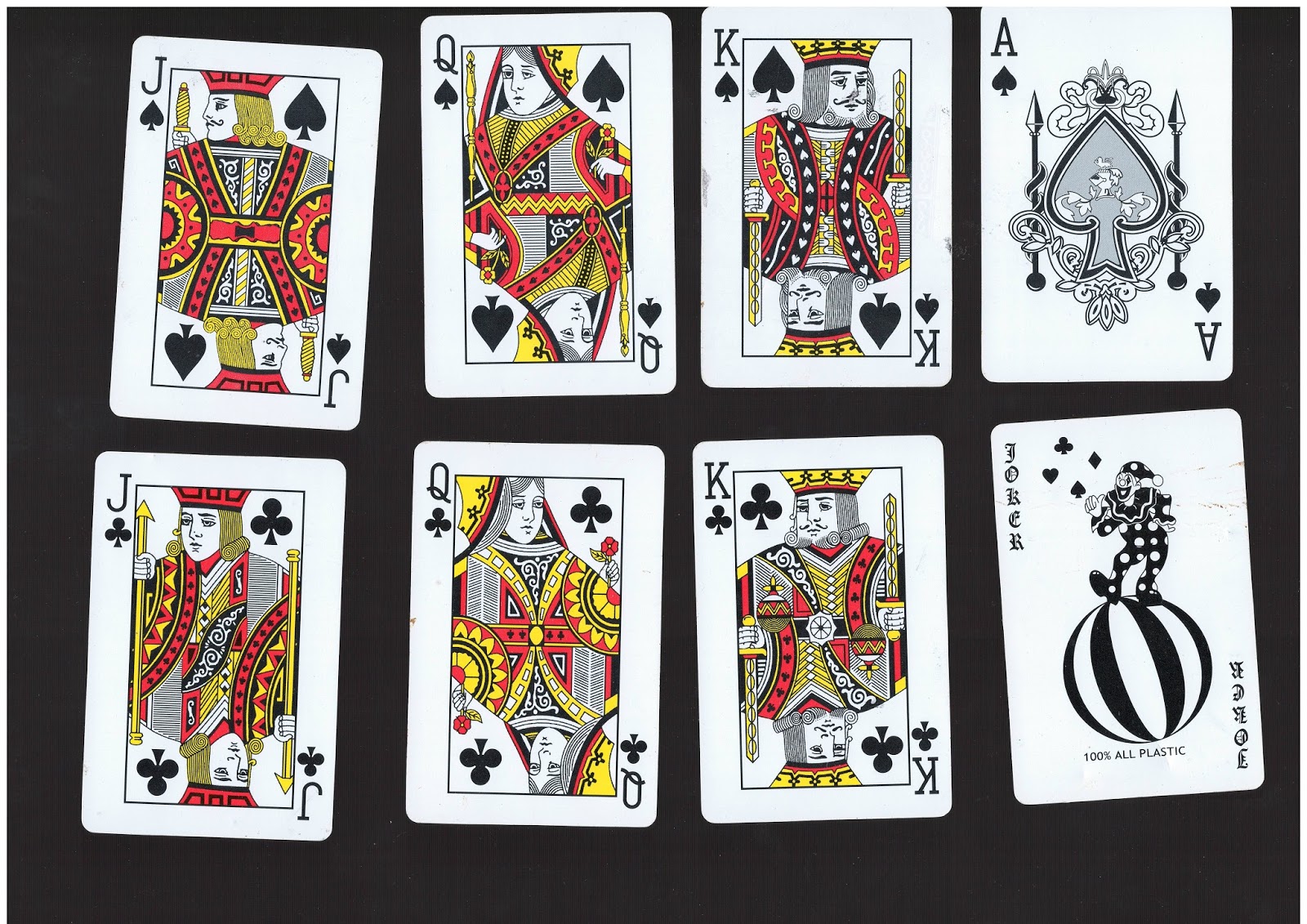
The suits of Spades and clubs. The pattern is printed in three colours, for reasons of economy. Note the Queen of spades, whose printing is much lighter than the rest. The Joker is similar to the ones printed by Piatnik 

Hearts and Diamonds. Note the symbol on the K. of Diamond's breast. Might this be the maker's mark?

But, the real curiosity of these decks are their backs. They came in a bewildering variety of shades and varieties. Perhaps restricted by the convention of the faces, the printers decided to exercise their creativity on the other side of the cards. 

. Here are two eye-catching examples. The one on the right strikes me as an unusual choice of design for deck. 

.
Two more examples. The one on the Left is quite literally a "Bicycle" deck. The one on the right was also printed in other colours.

Friday, 17 June 2016

"Black Jack 21"

"Black Jack 21", Wetecs Sdn Bhd, 52+4

This deck represents one of the delights of card-collecting. Finding the unusual in unexpected places.
For all appearances this deck is utterly unremarkable. It is, like many tens of thousands, nay, millions of decks that grace the shelves of small shops all across the world, It is that tried-and-tested double-faced 52-card Anglo-American pattern. However, it is certain small details that catch the eye, and make even the most humble deck stand out.

The spades and clubs. Note the crown, delicately rendered in colour pencils that graces the ace of spades. We are told that the cards are made by, a Malaysian company; Wetecs Sdn Bhd. 

The Diamonds and hearts. At this point I should note that the back is an imitation of USPCs famous "Aladdin" cards. 
However, it is the jokers that the real charm of the deck lies. Instead of the usual jesters, we have four droll caricatures of a criminal being stuck in various circumstances. They are delicately rendered in colour pencil. The artist has taken care to incorporate playing cards into each of the scenes. 

Such are the delights of card-collecting, The little gems in unexpected places. 


Thursday, 7 January 2016

International pattern XII: Anon.

[International pattern], Anon. 52c+2
This anonymous deck of cards was purchased at an outlet of the renowned Japanese value goods store Daiso about 5 years ago. The cards are made of plastic.


The first thing that strikes one about these cards is the simplicity of the design. The cards are done in only 3 colours. This is not uncommon. However, unlike most cards, the courts are drastically simplified in design. 
In most decks of the international pattern, the dress of the courts is comprised of elaborate patterns. Here the draughtsman has removed most of the roundels and other such features, replacing them with simple cross-hatching. 
Here the cards are compared with a more standard deck. D stands for the anonymous deck, W stands for the Waddingtons deck.  The maker of the anonymous deck has adhered to the basic features of the pattern, despite simplifying it. The King of spades still holds a sword, and his Queen holds both a sceptre and a flower. 

But, some courts have been altered. The King of diamonds no longer holds an axe. Instead of a pair of spiked poles, the Jack of swords holds a sword. Perhaps this was the anonymous pack's draughtsman's attempt at "rationalizing" the pattern? 


Another feature of interest is the direction the court cards face. In the Waddingtons deck, all the court cards face to the left. In the Anonymous deck, some of the courts face to the right. This feature is present in the oldest cards of the international pattern, but not in today's cards. 
We wonder what caused the maker to so drastically simplify the courts. Perhaps it was a limitation of the printing process? When printing on plastic, it might be difficult to align the colours precisely. A simplified design would be to order.


Monday, 21 December 2015

"500s", Queen's Slipper : International pattern XI

"500s", Queen's slipper. 62c+1

 The following deck is used to play the game of "500". Although once popular, it appears to have died out almost entirely except in Australia.  The present deck of cards is made by what appears to be the only maker of playing cards in Australia, Queen's slipper. It appears that cheap, imported cards of appallingly low quality are far more commonly available.

  The feature that makes this particular deck unique are the additional pip cards. In red suits, the pips run from ace to 13, and in black suits, from ace to 12.


The court cards of this deck are fairly typical of the Anglo-American pattern. However, the faces and hands of the figures are printed in a pink tone. This is a rare feature, but certainty not unheard of. The Joker in the deck depicts a bird grabbing a serpent. The design is different from the jokers used by the maker in their standard decks.  The black suits have an 2 additional ranks a 11 and a 12. 
Here you see the red suits. While each of the black suits have two extra ranks, the red suits have three extra ranks; 11, 12 and 13. 
Although these cards are quite frequently encountered, it appears that the game is almost never played with the extra cards. In any case, the 11s, 12s and 13s are only used in the 6-player version of the game. The more typical 4-player version requires only 45 cards (Omitting the 2s, 3s and a pair of 4s). 

Friday, 27 February 2015

"Flying wheel 868" : International pattern X

Again, another deck of the international pattern, also from Indonesia.
Note that the scanning process has rendered the yellow parts more orange than they actually are. 

 Note the curious green colour of the backs. This is despite the fact that the box they are in ( below) is blue in colour 


Sunday, 9 November 2014

"Playing cards 727" : International pattern IX

  "Playing cards" [international pattern]  , "727", 52 + 3

This deck of playing cards was made in Indonesia, . It is yet another example of the most far-reaching of all patterns of playing cards; the international pattern.

This deck is a rather ordinary deck. It was cheaply produced , and printed in only three colours ( compare http://anthonylesq.blogspot.sg/2012/03/international-pattern-part-i.html and http://anthonylesq.blogspot.sg/2012/03/international-pattern-ii-anon.html).

However, perhaps the most attractive feature of the deck are it's ace of spades and back design. The Indonesians, lovers of pattern and ornament, have exercised their imagination into designing these two cards. The ace of spades is a baroque creation, a mass of acanthus and flowers forming the symbol of that suit. The back design is a equally elaborate pattern of tritons and mermaids, frolicking amongst vines.


Spades ( note ace)


The packaging also shows the ace of spades.


Diamonds.


The back design. The overall structure resembles the backs of "bicycle" playing cards, but far more elaborate.


Sadly, the jokers are less ornate than the backs or ace.


Sunday, 27 July 2014

Scenic aces 3- "Verona plastic coated speelkarten"

"Verona plastic coated speelkarten"- Anon, 52c + 3 jokers

If there is a deck of cards that can be called "international", this is it. Its courts are of the international, or Anglo-American pattern, but the indices are in Dutch. Likewise, the aces depict scenes from around the Netherlands.

It would be interesting to know what prompted the manufacturer of this deck to use the Anglo-American pattern for the courts whilst keeping the traditional scenic aces. Perhaps this was an exercise in economy ; The manufacturer could not get the plates for printing Dutch courts.


Thursday, 5 September 2013

"Playing cards" ( International pattern VII)

"Playing cards"[ international pattern]  ( Anon) , 52 +2 c.

The following example of the international pattern is somewhat of a curiosity. The only information of the maker is 'made in china". Despite this, our anonymous maker has clearly put some effort into his designs, as they are far more elaborate than more conventional decks, indeed, by more exalted makers.
For comparison, see http://anthonylesq.blogspot.sg/2012/03/international-pattern-part-i.html, for a more ordinary deck


Observe how the maker has carefully layered the blue and yellow to give the impression of green on some of the cards
The deck comes with two jokers. One is shown here. Unlike most modern decks, not all of the suit signs are in the top left corner. This feature is common to more ancient decks, printed before the late 19thc.
Here is a comparison with a more conventional deck, in this case, the famous bicycle brand

Tuesday, 3 April 2012

The international pattern- an overview

Behold, four Kings, in Majesty rever'd,
With hoary Whiskers and a forky Beard;
And four fair Queens whose Hands sustain a Flow'r,
Th' expressive Emblem of their softer Pow'r;
Four Knaves in Garbs succinct, a trusty Band;
Caps on their heads, and Halberds in their hand;
And particolour'd Troops, a shining Train,
Draw forth to combat on the Velvet Plain
.
(Alex. Pope- The rape of the lock)
Now that we have been through six decks of the international pattern , it is time to compare them all togeteher. The following dizen images would very much speak for themselves in describing the characteristics of this pattern;


Friday, 16 March 2012

The international pattern VI- Dal negro

Dal negro - "Poker 36" - 36c.
In our journey through the internatioal patterns, we shall now proced towards cards made by European makers. The most famous of these is the belgian cartamundi, but I shall now show a  very curiosus deck made by the Italian maker Dal negro.
  This deck is  unusual, for it does not have 52 cards in it. Rather, it has 36 cards, breaking to 9 cards in each suit, viz;
     6 ,7 ,8 ,9 ,10 , Jack  Queen,  King , Ace
In  europe, as some of my readers may know, it is normal to have decks to contain less than 52 cards, but it is very unusual to have a deck of the international pattern treated as such. One can only wonder what games are played with it. 

The deck aside,  the cards are not very unusual.
I note the similarity to the waddingtons deck ( see http://anthonylesq.blogspot.com/2012/03/international-pattern-part-i.html)
II- note the ace of hearts. it bears a little stamp that bears the makers name. this feature is perculiar to european makers.
III- note the Jack of clubs. along the middle of the figure, is a band that bears the maker's name. This feature is almost never found in Englush made cards, save the earliest ones.