Showing posts with label english pattern. Show all posts

Friday, 15 September 2017

'Crown" playing cards

' Crown' playing cards. 52c+2

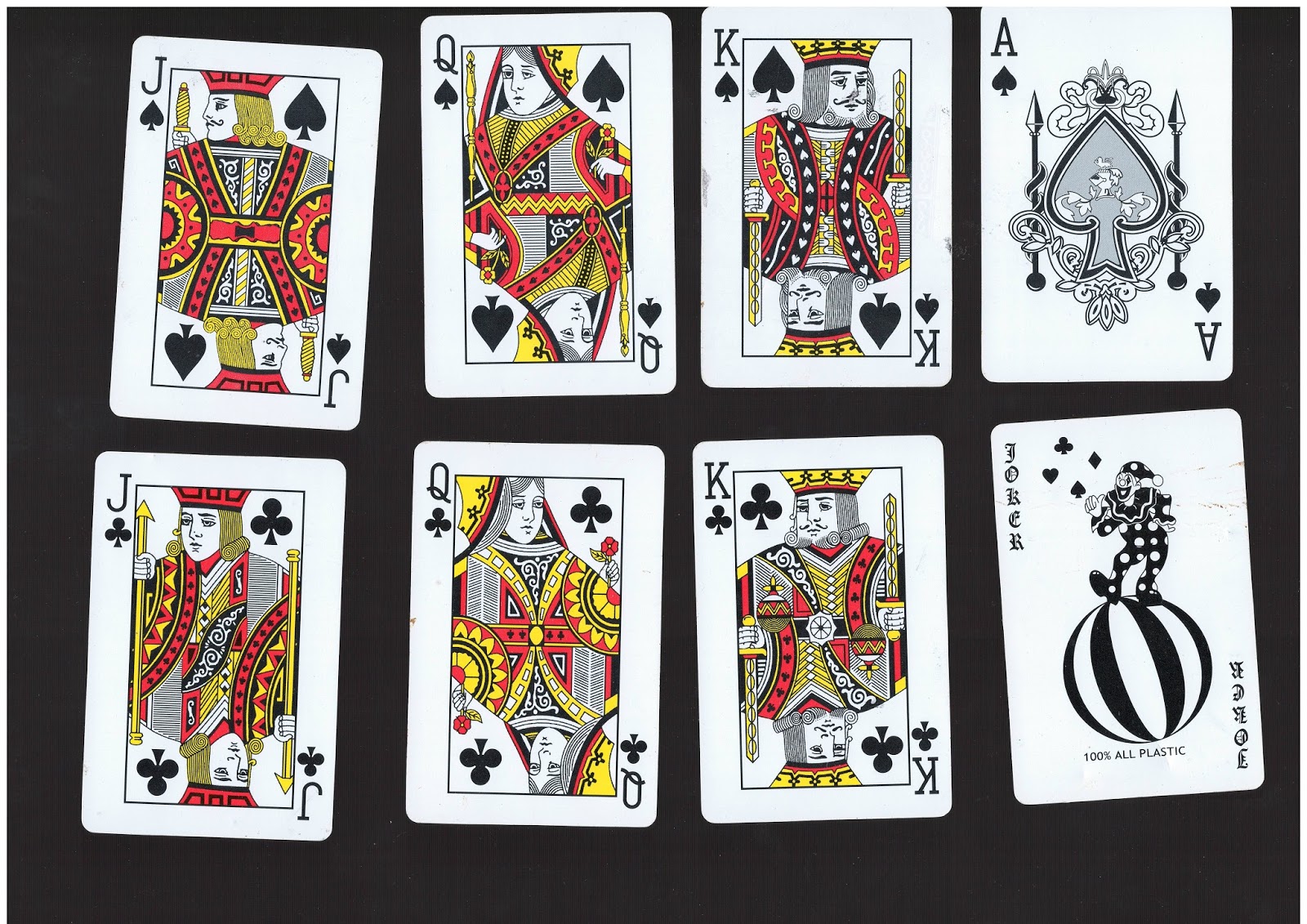
These cards were purchased in Singapore around 2010. They represent the extreme end of price in playing-card manufacture, each deck vending for $1.50 Singapore dollars. Despite ( Or because) of their low cost, they show some interesting features.
 First, they are made of plastic. Granted, this plastic very flimsy, and discolored, but the choice of material is not one would expect from cards thus cheap


The suits of Spades and clubs. The pattern is printed in three colours, for reasons of economy. Note the Queen of spades, whose printing is much lighter than the rest. The Joker is similar to the ones printed by Piatnik 

Hearts and Diamonds. Note the symbol on the K. of Diamond's breast. Might this be the maker's mark?

But, the real curiosity of these decks are their backs. They came in a bewildering variety of shades and varieties. Perhaps restricted by the convention of the faces, the printers decided to exercise their creativity on the other side of the cards. 

. Here are two eye-catching examples. The one on the right strikes me as an unusual choice of design for deck. 

.
Two more examples. The one on the Left is quite literally a "Bicycle" deck. The one on the right was also printed in other colours.

Thursday, 7 January 2016

International pattern XII: Anon.

[International pattern], Anon. 52c+2
This anonymous deck of cards was purchased at an outlet of the renowned Japanese value goods store Daiso about 5 years ago. The cards are made of plastic.


The first thing that strikes one about these cards is the simplicity of the design. The cards are done in only 3 colours. This is not uncommon. However, unlike most cards, the courts are drastically simplified in design. 
In most decks of the international pattern, the dress of the courts is comprised of elaborate patterns. Here the draughtsman has removed most of the roundels and other such features, replacing them with simple cross-hatching. 
Here the cards are compared with a more standard deck. D stands for the anonymous deck, W stands for the Waddingtons deck.  The maker of the anonymous deck has adhered to the basic features of the pattern, despite simplifying it. The King of spades still holds a sword, and his Queen holds both a sceptre and a flower. 

But, some courts have been altered. The King of diamonds no longer holds an axe. Instead of a pair of spiked poles, the Jack of swords holds a sword. Perhaps this was the anonymous pack's draughtsman's attempt at "rationalizing" the pattern? 


Another feature of interest is the direction the court cards face. In the Waddingtons deck, all the court cards face to the left. In the Anonymous deck, some of the courts face to the right. This feature is present in the oldest cards of the international pattern, but not in today's cards. 
We wonder what caused the maker to so drastically simplify the courts. Perhaps it was a limitation of the printing process? When printing on plastic, it might be difficult to align the colours precisely. A simplified design would be to order.


Monday, 21 December 2015

"500s", Queen's Slipper : International pattern XI

"500s", Queen's slipper. 62c+1

 The following deck is used to play the game of "500". Although once popular, it appears to have died out almost entirely except in Australia.  The present deck of cards is made by what appears to be the only maker of playing cards in Australia, Queen's slipper. It appears that cheap, imported cards of appallingly low quality are far more commonly available.

  The feature that makes this particular deck unique are the additional pip cards. In red suits, the pips run from ace to 13, and in black suits, from ace to 12.


The court cards of this deck are fairly typical of the Anglo-American pattern. However, the faces and hands of the figures are printed in a pink tone. This is a rare feature, but certainty not unheard of. The Joker in the deck depicts a bird grabbing a serpent. The design is different from the jokers used by the maker in their standard decks.  The black suits have an 2 additional ranks a 11 and a 12. 
Here you see the red suits. While each of the black suits have two extra ranks, the red suits have three extra ranks; 11, 12 and 13. 
Although these cards are quite frequently encountered, it appears that the game is almost never played with the extra cards. In any case, the 11s, 12s and 13s are only used in the 6-player version of the game. The more typical 4-player version requires only 45 cards (Omitting the 2s, 3s and a pair of 4s). 

Thursday, 5 September 2013

"Playing cards" ( International pattern VII)

"Playing cards"[ international pattern]  ( Anon) , 52 +2 c.

The following example of the international pattern is somewhat of a curiosity. The only information of the maker is 'made in china". Despite this, our anonymous maker has clearly put some effort into his designs, as they are far more elaborate than more conventional decks, indeed, by more exalted makers.
For comparison, see http://anthonylesq.blogspot.sg/2012/03/international-pattern-part-i.html, for a more ordinary deck


Observe how the maker has carefully layered the blue and yellow to give the impression of green on some of the cards
The deck comes with two jokers. One is shown here. Unlike most modern decks, not all of the suit signs are in the top left corner. This feature is common to more ancient decks, printed before the late 19thc.
Here is a comparison with a more conventional deck, in this case, the famous bicycle brand

Thursday, 2 May 2013

Circular playing cards I- house of marbles

"Circular playing cards/ Round playing cards" - House of marbles, 52c.+2

  Circular playing cards, although unusual, are by no means rare. The Indian Ganjifa cards are mostly circular in shape. This is doubtless due to the relative ease of making circles of regular shape than rectangles ( To make circles, one only needs a pair of dividers or compasses to trace the designs, whilst drawing rectangles calls for much work involving straightedges, which is wont to be inaccurate).
   However, as far as the west is concerned, circular playing cards are more often than not produced as novelties. This particular example is an English pattern. However, some modifications have been made to suit the format.


Spades
 
Notice that the court cards are repeated four times on each card, much like spokes on a wheel. In order for that to be achieved, the figures have to be stripped down a bit, thus making the king of spades look like four skittles!. The indexes are also repeated around the card in a similar fashion
The Joker displays a knight ( St, George?) slaying a dragon.


Diamonds
Note that although the courts have been repeated 4 times, the arrangement of the pips are as with a normal deck.
 
 
Clubs
Hearts.
The pips on the court cards seem to have been inverted


Sunday, 1 July 2012

Miniature cards ( English)

Miniature cards - anon ( english maker) , 53c. +joker
 
 Another miniature deck, probably from the 1940s-50s.It is ( apparently ) made in England. I wonder why this would be considered worth mentioning, as the deck is printed in a rather crude fashion; with some cards not aligned properly.
   However, it is a pretty little thing - observe the curious illustration on the back , depicting a pair of dogs on leashes, being walked as snow falls. The same design is reproduced on the wrapper
   Another curious feature is the black band that seperates the two halves of the courts. I thing that this was intended to be filled in with a customer's name (but given the poor quality of the printing , the name may not have been legible)
 Lastly, the deck contains a pair of two-of-diamonds. I have no knowlege how that card got there


joker, back,  and wrapper

the other side of the wrapper.

Thursday, 21 June 2012

Miniature deck - Anon

Miniature deck- Anon , 52c.
 The miniature ( 4.5 x 2.8 cm) deck is somewhat of a mstery. The Desigin of the court cards indicates that the maker was imitating the English pattern, but there are many diffrernces. (see http://anthonylesq.blogspot.sg/2012/03/international-pattern-part-i.html)


Tuesday, 3 April 2012

The international pattern- an overview

Behold, four Kings, in Majesty rever'd,
With hoary Whiskers and a forky Beard;
And four fair Queens whose Hands sustain a Flow'r,
Th' expressive Emblem of their softer Pow'r;
Four Knaves in Garbs succinct, a trusty Band;
Caps on their heads, and Halberds in their hand;
And particolour'd Troops, a shining Train,
Draw forth to combat on the Velvet Plain
.
(Alex. Pope- The rape of the lock)
Now that we have been through six decks of the international pattern , it is time to compare them all togeteher. The following dizen images would very much speak for themselves in describing the characteristics of this pattern;