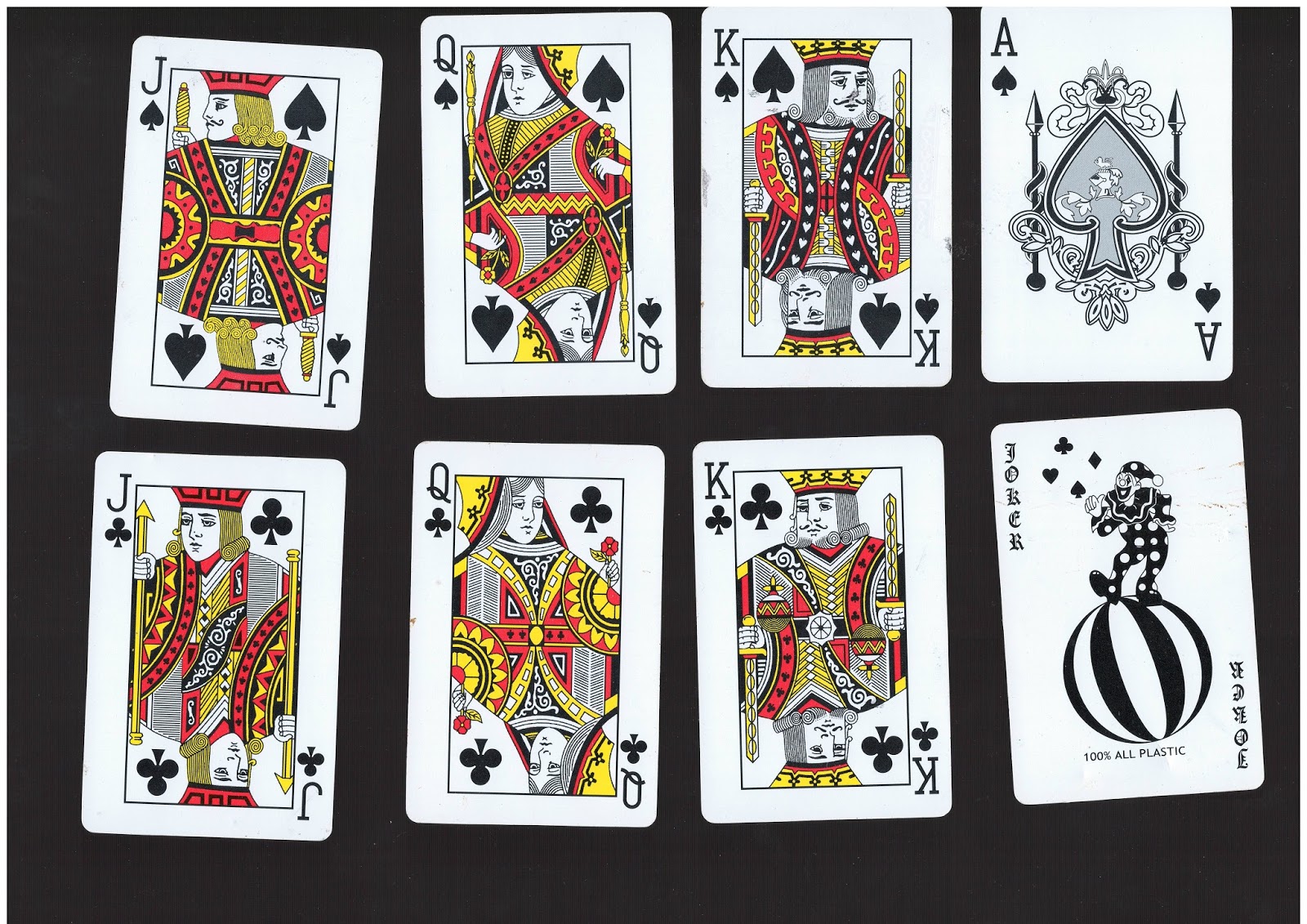
Showing posts with label anon playing cards. Show all posts

Tuesday, 5 March 2019

Transparent playing cards (2)

Transparent Playing cards, Anon, 52+2c. 

Here is another example of Transparent playing cards.  See here for one previously featured, and for a fuller explanation of the cards. The author recalls that this deck ( as well as the previous one) was purchased in the Japanese discount store Daiso. 
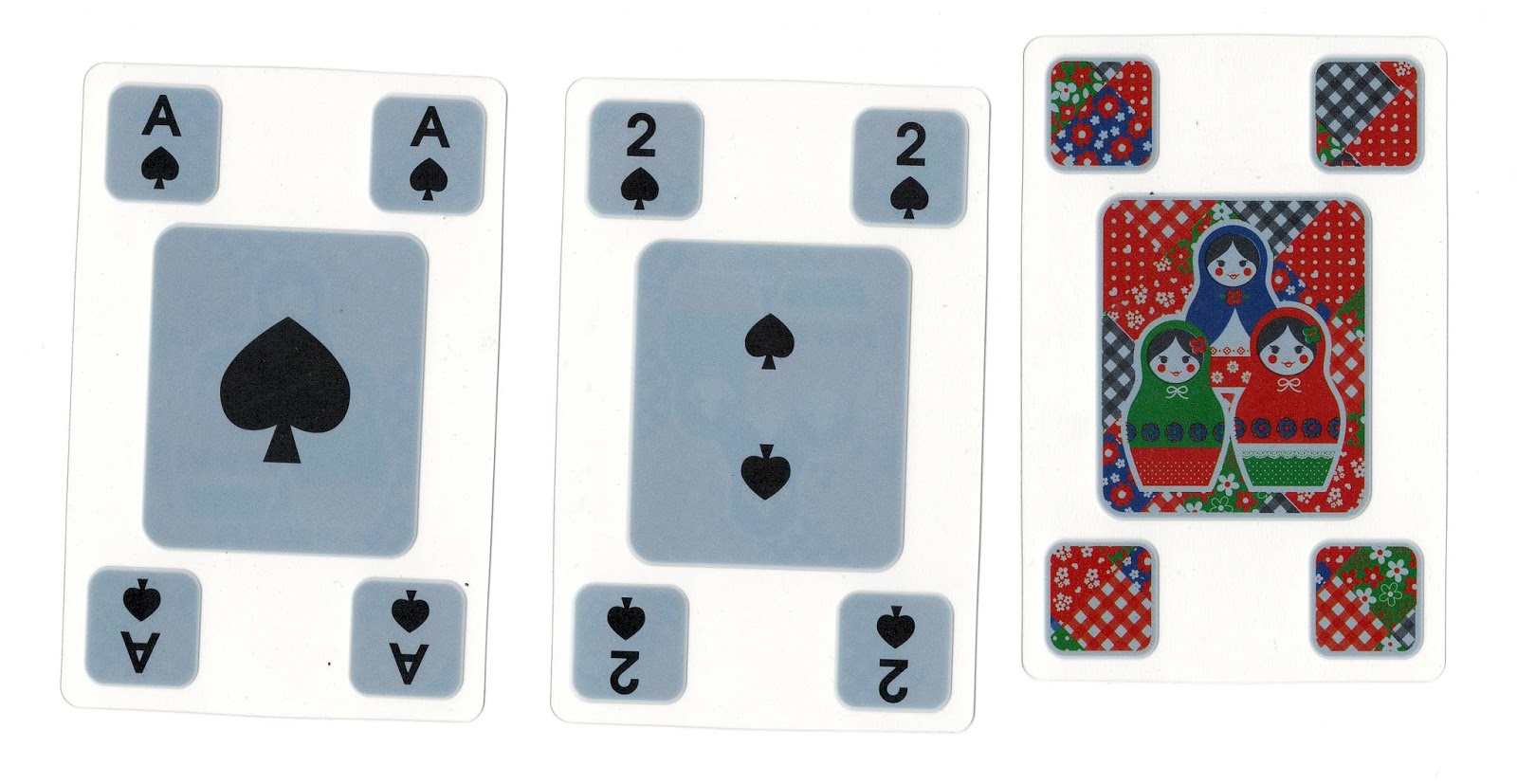
 The cards in this deck are slightly more complex than the one previously featured, Instead of simple indices, the pips are actually depicted on the cards. In turn there are also four indices to each card, instead of two. The back displays a charming design of Matryoshka
More cards are here depicted. they are overlaid with text, to show their transparency. Like the previous deck, the manufacturer has printed patches of opaque ink on the otherwise transparent cards. On these patches are printed the pips. 
Note the unusual arrangement of the pips, as well as the non-figurative court-cards. The Joker, meanwhile retains a human appearance 

Unfortunately, the opaque parts of the cards are not so opaque when strong light is shone against them. 

Friday, 15 September 2017

'Crown" playing cards

' Crown' playing cards. 52c+2

These cards were purchased in Singapore around 2010. They represent the extreme end of price in playing-card manufacture, each deck vending for $1.50 Singapore dollars. Despite ( Or because) of their low cost, they show some interesting features.
 First, they are made of plastic. Granted, this plastic very flimsy, and discolored, but the choice of material is not one would expect from cards thus cheap


The suits of Spades and clubs. The pattern is printed in three colours, for reasons of economy. Note the Queen of spades, whose printing is much lighter than the rest. The Joker is similar to the ones printed by Piatnik 

Hearts and Diamonds. Note the symbol on the K. of Diamond's breast. Might this be the maker's mark?

But, the real curiosity of these decks are their backs. They came in a bewildering variety of shades and varieties. Perhaps restricted by the convention of the faces, the printers decided to exercise their creativity on the other side of the cards. 

. Here are two eye-catching examples. The one on the right strikes me as an unusual choice of design for deck. 

.
Two more examples. The one on the Left is quite literally a "Bicycle" deck. The one on the right was also printed in other colours.

Thursday, 7 January 2016

International pattern XII: Anon.

[International pattern], Anon. 52c+2
This anonymous deck of cards was purchased at an outlet of the renowned Japanese value goods store Daiso about 5 years ago. The cards are made of plastic.


The first thing that strikes one about these cards is the simplicity of the design. The cards are done in only 3 colours. This is not uncommon. However, unlike most cards, the courts are drastically simplified in design. 
In most decks of the international pattern, the dress of the courts is comprised of elaborate patterns. Here the draughtsman has removed most of the roundels and other such features, replacing them with simple cross-hatching. 
Here the cards are compared with a more standard deck. D stands for the anonymous deck, W stands for the Waddingtons deck.  The maker of the anonymous deck has adhered to the basic features of the pattern, despite simplifying it. The King of spades still holds a sword, and his Queen holds both a sceptre and a flower. 

But, some courts have been altered. The King of diamonds no longer holds an axe. Instead of a pair of spiked poles, the Jack of swords holds a sword. Perhaps this was the anonymous pack's draughtsman's attempt at "rationalizing" the pattern? 


Another feature of interest is the direction the court cards face. In the Waddingtons deck, all the court cards face to the left. In the Anonymous deck, some of the courts face to the right. This feature is present in the oldest cards of the international pattern, but not in today's cards. 
We wonder what caused the maker to so drastically simplify the courts. Perhaps it was a limitation of the printing process? When printing on plastic, it might be difficult to align the colours precisely. A simplified design would be to order.


Saturday, 28 March 2015

"Playing cards No. 7728"

"Playing cards No. 7728", anon,  52+2c

The present deck of cards is most interesting. It was found in a small haberdashery shop in Singapore, where it lay forgotten, perhaps for nearly 30 years ( judging by the pictures on the cards), until the author purchased it from the somewhat bewildered shopkeeper.

The cards are of Chinese make ( as the inscription on the box tells us). The box itself displays an image of a embracing couple. Garish rainbow lettering informs us that it contains playing cards:


The playing cards themselves display similar images. Each and every one of them contains a couple in some state of embrace, or doing some activity together.
The images may have been magazine illustrations, or film  posters. Note the four of spades, where what appears to be the title of a magazine on the top. Also note the seven of hearts. In a somewhat inexplicable scene, a woman and a devil are seen together. \
Some cards  have an unusual horizontal format, as seen in the six of diamonds & seven of spades. In a particularly inexplicable moment, a couple are seen buying CDs

More cards from the set. Note the four of hearts. Upon closer inspection, the reflection on the sunglasses of the couple reveal a series of bingo balls

All the cards, and the box are printed on relatively poor quality card. The present deck appears to be a novelty deck. However, that deck of cards was sold along with a few other decks of similar make, one of which was a Oral-B  advertising deck. 

. I would most happily accept any information about possible sources for the pictures on the present deck. 


Thursday, 5 September 2013

"Playing cards" ( International pattern VII)

"Playing cards"[ international pattern]  ( Anon) , 52 +2 c.

The following example of the international pattern is somewhat of a curiosity. The only information of the maker is 'made in china". Despite this, our anonymous maker has clearly put some effort into his designs, as they are far more elaborate than more conventional decks, indeed, by more exalted makers.
For comparison, see http://anthonylesq.blogspot.sg/2012/03/international-pattern-part-i.html, for a more ordinary deck


Observe how the maker has carefully layered the blue and yellow to give the impression of green on some of the cards
The deck comes with two jokers. One is shown here. Unlike most modern decks, not all of the suit signs are in the top left corner. This feature is common to more ancient decks, printed before the late 19thc.
Here is a comparison with a more conventional deck, in this case, the famous bicycle brand

Thursday, 23 May 2013

Transparent playing cards ( 1 )

Transparent playing cards- anon- 52 + 2 c.

Transparent playing cards would surely seem to be somewhat of an outright impossibility- How would one play with a deck that would allow light to pass through it, & yet conceal what cards you are holding from your opponents?
  However, such cards are made, and the are perfectly playable. However, it can be said that the makers almost always "cheat" when designing the cards. Firstly, to make them transparent, they ay are printed on thin sheets of plastic.
the cards overlaid on text , showing their transparent nature

As you may observe from the above image, only a certan portion of the cards are transparent, the rest covered with a form of design which is opaque. It is on this design where the face side of the cards are printed on. In this case, the maker has decided to only print the indexes of the cards and nothing else.

a closeup of the above. Note the ornamented borders and centerpiece.

the cards held up to strong light


the same, held up the other way. Note the opaque ovals, on which the indexes are printed

However, at least in this instance, the maker has decided, presumedly for reasons of economy,  not to make the whole of the back design opaque, but only the small oval on which the indexes are printed. This causes the little ovals on which the indexes are printed to stand up when the cards are held up to strong light.

The cards in question were purchased from the Japanese discount store Daiso.  


Tuesday, 13 March 2012

The international pattern II - anon

International pattern,( anon) 52c. + 2 jokers (lost)
Now, we shall now come towards the second part of our series on the international pattern ( the first part is at http://anthonylesq.blogspot.com/2012/03/international-pattern-part-i.html), in which we shall see another variant of this pattern, by a unknown ( east asian?) maker

Note the following variations from the waddingtons deck ( http://anthonylesq.blogspot.com/2012/03/international-pattern-part-i.html)

I the court cards have been simplified somewhat
II only three colurs have been used- Red, black, and yellow. This is presumabably for reasins of economy
III the indexes are in only 2 corners, probably for the reason stated above.