Thursday, 10 March 2016

Dutch Scenic aces 4 :Hooghoudt

"Hooghoudt: 56 Geplastificeerde Speelkarten". Cartamundi, 52c+2

The following deck is a pleasing advertising deck made by the distillers Hooghoudt. Most advertising decks carry the advertisements on the back only. However, the traditional Dutch scenic aces offer additional possibilities. Instead of the traditional "views of the world", the scenic aces here display views around the company's brewery.

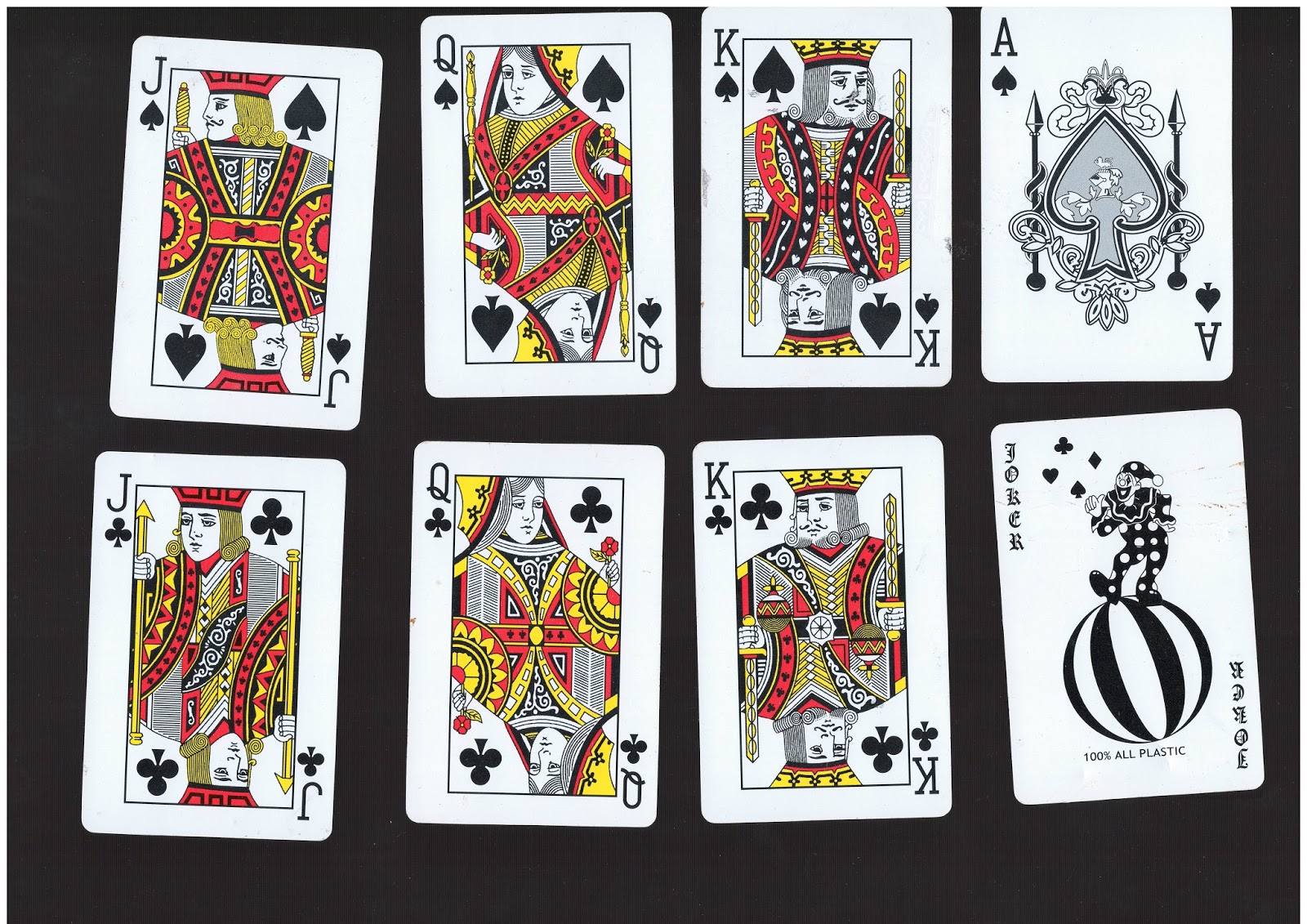
Spades and clubs. This is the same "Dutch pattern" as seen in the Prima speelkaarten 1410, but admittedly more colourful. 

Hearts and Diamonds. Note the rather tasteful use of purple in the Queen of diamond's dress. 

The Scenic aces. Unlike the other decks ( as Here and Here), the Hooghoudt deck is illustrated using photographs-- a suitable modernization. 

The other side of the aces. 

One of the Jokers and the back. Although the title of the deck says "56 cards" ( implying 4 jokers) only 2 are present in the deck. They are the standard Cartamundi Jokers. 
The backs advertise Hooghoudt Beerenberg , a sort of spiced gin. The alcoholically inclined reader may find the following link useful:http://www.hooghoudt.com/ . Be prepared to enter your date of birth. 

Thursday, 18 February 2016

Australian Toy cards 1: Fish

"Fish card game", Anon, 36c+1

 The following set of cards was purchased at a thrift shop in a remote Australian town. These cards came in a pack of three. All of these cards are designed for the express purpose of a particular game. Although they were purchased in Australia, they might have been printed in America. 

 Let us speculate for some moments on why this deck was produced.  Most of the games that are played with this set of three cards can be played with normal playing cards. However, owing to the shady associations of normal playing cards, parents might be hesitant to allow them to fall into the hands of children. 
   Hence, manufacturers would be more than happy to manufacture "non playing cards" for the purposes of children. In any case, it would also be economical for manufacturers. Why bother to invent a new game when you can simply design new cards for an old one? 

****
The present deck is intended for a game normally called "Go fish". This game involves players capturing cards in a central "pool" with cards in their own hand. In most versions, whoever captures the most cards wins.
  In this deck, the maker has taken a hint from the fishy name of the game. All nine subjects of the deck are fish. Each of the subjects is repeated 4 times to generate the deck of 36 cards.  


The illustrations of the deck are clearly interned to appeal to children.  Each of the cards has a border of a distinctive colour. Perhaps this acts in a similar fashion to the indexes of normal cards?
Most of the subjects of the deck are oceanic creatures. Perhaps the "pool" would be more properly called the "ocean"?

Tuesday, 26 January 2016

Four colour cards/四色牌 2:

"2001 龙凤四色牌”  112c +7
This particular deck of playing cards is yet another variation of the 四色牌, playing cards, or as some English authors call them "chess cards" . The Chinese name reflects the suit system of the cards. Four colours, Red, Yellow, Green and White. The English name reflects the ranks in each of the suits, which correspond to the pieces in the Chinese version of Chess.

  Although purchased in Singapore, this particular pattern is not common there. In all my years of collecting, I have only seen this pattern twice. On both occasions I bough the decks in question.
For a Comparison with a more typical pattern, please see http://www.wopc.co.uk/singapore/double-elephant  and http://anthonylesq.blogspot.sg/2013/03/four-colour-cards-hokkien.html

The red and yellow suits. The ranks are, From Right to Left: General 帥,Guard 仕, Minister相,  Chariot俥, Horse 傌, Cannon 炮, and Infantryman. 兵
Despite being printed in the PRC, these cards are written in Traditional Chinese characters. Also note the company name (龙凤, "Dragon and Phoenix")written in the space between the cards. 

The Suits of Green and White. Like real Chinese chess sets, ( see here and Here ) The pieces for opposing sides are written using different characters. The ranks are, Again, General 將,Guard士, Elephant 象 (The Chinese words for "Elephant"and "Minister" are homophones, hence the substitution ) , Chariot 車, Horse馬, Cannon 包.(Amusingly, this character on its own means "Bun").and soldier. 卒

The "Title cards" (A, B) and the five "Jokers (C-G). The text on card A gives the name of the company, and an auspicious greeting. Card B is a Quality control certificate. (合格证). It also gives the " complaints hotline". The card informs us that the company is located in Fuzhou. 

. The jokers ( C, D, E, F, G)  are slightly more cryptic. They apparently refer to ranks of the Chinese Nobility. EDIT: The jokers depict the five ranks of  ancient Chinese nobility mentioned in the Book of rites.  In descending  order of rank, they are 公 (G)、侯(F)、伯(E)、子(D)、男(C).
 In any case, the games that are played with the deck do not appear to use them. 

The box. You can see it is fairly battered. 


Thursday, 7 January 2016

International pattern XII: Anon.

[International pattern], Anon. 52c+2
This anonymous deck of cards was purchased at an outlet of the renowned Japanese value goods store Daiso about 5 years ago. The cards are made of plastic.


The first thing that strikes one about these cards is the simplicity of the design. The cards are done in only 3 colours. This is not uncommon. However, unlike most cards, the courts are drastically simplified in design. 
In most decks of the international pattern, the dress of the courts is comprised of elaborate patterns. Here the draughtsman has removed most of the roundels and other such features, replacing them with simple cross-hatching. 
Here the cards are compared with a more standard deck. D stands for the anonymous deck, W stands for the Waddingtons deck.  The maker of the anonymous deck has adhered to the basic features of the pattern, despite simplifying it. The King of spades still holds a sword, and his Queen holds both a sceptre and a flower. 

But, some courts have been altered. The King of diamonds no longer holds an axe. Instead of a pair of spiked poles, the Jack of swords holds a sword. Perhaps this was the anonymous pack's draughtsman's attempt at "rationalizing" the pattern? 


Another feature of interest is the direction the court cards face. In the Waddingtons deck, all the court cards face to the left. In the Anonymous deck, some of the courts face to the right. This feature is present in the oldest cards of the international pattern, but not in today's cards. 
We wonder what caused the maker to so drastically simplify the courts. Perhaps it was a limitation of the printing process? When printing on plastic, it might be difficult to align the colours precisely. A simplified design would be to order.


Monday, 21 December 2015

"500s", Queen's Slipper : International pattern XI

"500s", Queen's slipper. 62c+1

 The following deck is used to play the game of "500". Although once popular, it appears to have died out almost entirely except in Australia.  The present deck of cards is made by what appears to be the only maker of playing cards in Australia, Queen's slipper. It appears that cheap, imported cards of appallingly low quality are far more commonly available.

  The feature that makes this particular deck unique are the additional pip cards. In red suits, the pips run from ace to 13, and in black suits, from ace to 12.


The court cards of this deck are fairly typical of the Anglo-American pattern. However, the faces and hands of the figures are printed in a pink tone. This is a rare feature, but certainty not unheard of. The Joker in the deck depicts a bird grabbing a serpent. The design is different from the jokers used by the maker in their standard decks.  The black suits have an 2 additional ranks a 11 and a 12. 
Here you see the red suits. While each of the black suits have two extra ranks, the red suits have three extra ranks; 11, 12 and 13. 
Although these cards are quite frequently encountered, it appears that the game is almost never played with the extra cards. In any case, the 11s, 12s and 13s are only used in the 6-player version of the game. The more typical 4-player version requires only 45 cards (Omitting the 2s, 3s and a pair of 4s). 

Sunday, 13 September 2015

Tell pattern , Bonaparte

(Tell pattern), Bonaparte, 32c +1

The following deck is made by Bonaparte, a Czechoslovakian company. It is based on the  "Tell pattern", but has several notable differences.
The first differnce is the lack of names. Most "tell pattern" decks name the court cards and aces. For example, the ace of leaves ( Top row, first card from left) is typically labelled ozsp/herbst , meaning autumn. 
The court cards in such decks are usually labelled, which is also absent in this deck. For example, the ober of acorns ( Bottom row, 3rd from left) is titled "William Tell". This is absent, but the card still depicts Tell-- The cross-bow he holds is Tell-ing! 

Apart from the differences above, the cards are quite similar to most patterns. The only differnce appears to be the use of more muted palate of colours. 
( compare http://anthonylesq.blogspot.sg/2011/10/magyar-kartya.html  and http://anthonylesq.blogspot.sg/2011/11/miniature-tell-pattern-piatnik.html )
 Comparisons between the present deck ( marked B) and a more typical deck, by Piatnik. 
(marked P)  The top row shows the court cards, and the differences are quite obvious. 
The makers seem to have removed all references to the William tell legend in the pip cards. For example, in the 8 of hearts, ( Bottom row, first pair from left), the Piatnik deck depicts a scene in the  William tell legend where he steers a boat across  a stormy lake. The Bonaparte deck shows a simple sailing ship. 
Although the scenes in the cards have been altered, the designers of the Bonaparte deck have decided to retain the theme of the cards. The 7 of bells ( First pair from left) depicts a parting couple, but the piatnik deck includes a child-- presumably Tell's son. The 7 of hearts ( second pair from left) instead of showing Gessler's death, shows a simple mounted figure. 


Wednesday, 3 June 2015

"Nolbu"hwatu

"Nolbu", 48c+6

When Korea was under Japanese occupation, the Koreans took a liking to the Japanese games played using hanafuda. The Koreans subsequently developed their own games, and at length, a native Korean pattern.  (If you are not already familiar with the hanafuda, this is a useful link: http://anthonylesq.blogspot.sg/2012/02/hanafuda-nintendo.html )
 
  The first major difference is the materials from which the decks are made. Japanese cards are made of thick cardboard, while the korean hwatu are made of stiff sheets of plastic.

 I have seen people who are ignorant of this fact lodge complaints on an online retailer, feeling cheated, as the Japanese hanafuda they bought were printed on paper instead of the expected plastic!

Nevertheless, despite being made of plastic, the hwatu retain a red border around the cards; an imitation of the japanese cards and their turnover edges.

 The suits of January and febuary. note the “光 character on the card with the crane, ( Top row, 1st from right) This character marks out certain valuable cards in the deck. 
The suits of  march. and april Note the " ribbon" card ( Top row, 2nd from right) . The inscription on this ribbon is in Korean. No-one seems to understand what it says.  

The Suits of May and June . One of the features of the Hwatu are the use of a light, almost turquoise blue. The standard Japanese cards use a deep purple instead of this color. .  

The Suits of  July and August. Another key feature of the hwatu is the deep black used. The Hanafuda use a grey colour instead of the black. It is thus possible to see the veins of the leaves, and blades of grass. This is impossible in the hwatu. Note the " moon"  card ( 2nd row, 1st from right). It contains the visage of nolbu, a character in a Korean folktale. 

 September. and october 

November and December. 


Here are the extra " joker" cards that are peculiar to the Korean game. They display figures relevant to the story of Nolbu and Heungbu. Nolbu (1) was a miser, who had a brother called Heungbu.
Their father died. Nolbu took all their father's wealth for himself,  and drove  Heungbu out of the luxurious house in which they had previously lived,  (2). Heungbu was forced to stay in a small hut, where a swallow that they saved (3) presented them with a seed. When it was planted, it grew gourds that were filed with treasure (4). 
Nolbu grew jealous, and forced a swallow to present him with a similar seed (5). When that was planted, the gourds that it grew were filled with demons, who tore him to pieces ( not shown ). It seems that the ingenious maker has used the elements of the story described to illustrate the various bonuses that the cards confer. Any translation is appreciated.